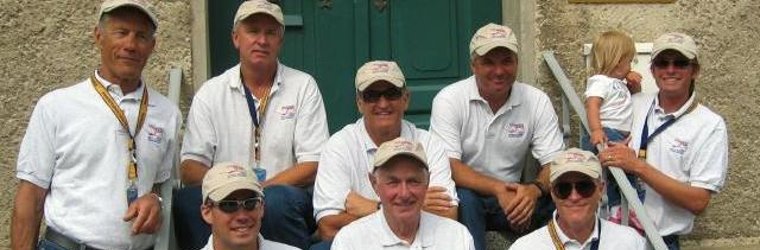
Just a couple of hours left to WGC 2008 at Lüsse. With the competition period over, we naturally have beautiful weather. Some are planning to stay and fly today, but most, including the entire US Team, will hit the road early this afternoon.
Last night’s farewell dinner was a huge success. The briefing hangar was packed, buffet-style food of a quality far above what’s typical of such events was served in vast quantities, and a four-man saxophone band produced music that met the approval of all (and at a volume that allowed conversation, a rare and welcome innovation). In addition to barrels of beer and cases of wine, a lot of fiery liquids were being passed around. Paul Weeden had a liter of Jim Beam that attracted a lot of attention; the Russians had a bottle of vodka that seemed bottomless.
At the end of the meal we were invited out on to the runway (in rain that had continued all day, finally tapering to a gentle mist) to witness something no one expected: a short and very artistic fireworks display. It was a grand end to a festive evening.
Yesterday’s mission was to get equipment sorted out and trailers and cars packed for a quick getaway after today’s ceremony ends. Steady rain put a premium on hangar spaces into which a fuselage could be rolled for work. This to some extent conflicted with preparations for the party, but all work was completed and, as I’ve noted, the party organizers achieved complete success.
This morning the big issue is the disappearance late last night of the banners lining the briefing hall (where, in just 20 minutes, the Closing Ceremony is scheduled to start). Officials are Not Amused. No one seems to have any idea who is responsible. I suspect this has something to do with Annex Z (see the reports for August 5th and 6th) which seemed to suggest that something would happen within 24 hours of the closing ceremony.
The closing ceremony is now over. Winners have received their trophies, national anthems of Hungary, France and Germany were played by a small (and very competent) orchestra. Trailers are flooding the streets leading out of Lüsse. The well-trampled grass where trailers and gliders were parked (you can easily see their outlines) will now have a chance to recover. Club gliders can at last emerge from their hiding places
I’ll close with compliments to Competition Director Herbert Märtin and Deputy Director Natalie Lübben. For an event on this scale, many dozens of people will have worked hard for a very long time. But few of them will have done as much as Herbet and Natalie. It must be very satisfying for them to see their efforts lead to this success.
As for the banners, their fate remains unknown. A rumor was going around that Team HW might have been involved (what there could be in Heinz Weissenbuehler’s past that would allow anyone to believe such things I’m unable to say), but this proved entirely unfounded. I’ll post an addendum to this report if and when I learn the solution to this mystery.

Thanks to Our Sponsors!
Saturday, August 16, 2008
Friday, August 15, 2008
Our two “podium” pilots – Doug Jacobs (first in 18-Meter class) and Karl Striedieck (third in 15-Meter class) – received their daily prizes and the applause of all at this morning’s pilot briefing. It was gratifying to end on a high note, for the pessimists were right about today’s weather: hopeless for soaring. We have low clouds and light rain, with no change predicted until tomorrow morning. WGC 2008 thus has ended a day earlier than we’d hoped.
We wound up with 8 competition days – a somewhat disappointing total by the standards of recent WGCs. The east winds and excellent weather of the practice period were gone by the start of competition, and we have struggled with a series of low-pressure systems generally passing north of Germany. Though many would have liked to do a bit more flying, no one believes that the competition here was anything other than a fair test of soaring skills.
Tasks made good use of the rather windy and often tricky weather. We had a few undercalls – the really severe tasking often said to be characteristic of top-level competition seems to be a thing of the past (there have been few 5+ hour tasks in any of the past three WGCs). We also had one day on which nearly all gliders of the final two classes were unable to get home; this was in part due to weather somewhat weaker than expected, and also to a launch that took a bit longer than it should.
The accurate task-setting was due in no small part to some of the best weather forecasting ever at any gliding competition. If contest weatherman Erland Lorenzen wasn’t strictly perfect, he was closer to perfection than a glider pilot has any right to expect. He received a long and well-deserved ovation at this morning’s final pilot briefing.
Indeed, the entire contest organization for WGC 2008 has been excellent. Strong points include a superb airfield, a task area second to none for landability, plenty of competent volunteers, well-organized and informative briefings, high-quality food service on the airfield, and a relaxed attitude toward regimentation (e.g. the general rule for driving around the airfield has been “Anything that doesn’t cause problems is OK.”) The early problem of a long launch was addressed, and by the end of the contest all gliders were in the air in not much more than an hour.
Though not yet formally recognized (that will happen at tomorrow’s closing ceremonies) the champions have been decided. In 15-Meter class, György Gulyas of Hungary, the pilot most would have named the pre-contest favorite, has prevailed by a convincing margin over 3-time World Champion Janusz Centka of Poland. György was more consistent than any pilot here, and showed himself willing to charge out on his own when conditions were right for this. Mark Leeuwenburgh of the Netherlands is third, by dint of steady flying and especially by staying clear of the trouble that overtook several of his rivals during the final task.
In 18-Meter class, Olivier Darroze of France is the champion, showing a first-rate mix of brilliance and consistency. He flew a typically disciplined contest with teammate Frederic Hoyeau, under the expert direction of captain Eric Napoleon. Not all teams had their team flying working smoothly here, but in 18-Meter class Team France certainly did. Ronald Termaat of the Netherlands was second; he led for much of the race, until overhauled by Olivier with a couple of days to go. Karol Staryszak of Poland was third; he started very well, but stumbled just a bit when his competitors were surging.
Open class offers an interesting view of team flying. Michael Sommer and Tassilo Bode of Germany are as smooth and experienced a team pair as have ever flown gliders, and it should be no surprise to see them at the top of the final scoresheet. It took them a while to get into top gear, which allowed Laurens Goudriaan of South Africa, flying brilliantly, to stay in front for several days. But their performance in the second half of the contest smoothly carried them past Laurens. Compare this to Holger Karow, who likes to fly on his own – and in 2003 made this strategy work superbly. He had some excellent flights here, but not quite the consistency that would have earned him a medal.
We’ve received lots of email at the US Team address (for which all here are grateful). A couple of items were comments on some things I’ve reported. I noted that Alena Netusilova’s second-place finish on August 9th was “possibly the best-ever daily WGC result by a woman.” In fact, on the 4th day of the 1952 World Gliding Championships in Spain, Hanna Reitsch of Germany placed second in the 2-seater class.
I also reported burn marks on the wingtip of on of the Lo-100 gliders participating in the airshow. In fact, these were hot wax droplets sputtered off the smoke bomb in its dying moments – they are not dangerous to the wing and are easily cleaned up.
We wound up with 8 competition days – a somewhat disappointing total by the standards of recent WGCs. The east winds and excellent weather of the practice period were gone by the start of competition, and we have struggled with a series of low-pressure systems generally passing north of Germany. Though many would have liked to do a bit more flying, no one believes that the competition here was anything other than a fair test of soaring skills.
Tasks made good use of the rather windy and often tricky weather. We had a few undercalls – the really severe tasking often said to be characteristic of top-level competition seems to be a thing of the past (there have been few 5+ hour tasks in any of the past three WGCs). We also had one day on which nearly all gliders of the final two classes were unable to get home; this was in part due to weather somewhat weaker than expected, and also to a launch that took a bit longer than it should.
The accurate task-setting was due in no small part to some of the best weather forecasting ever at any gliding competition. If contest weatherman Erland Lorenzen wasn’t strictly perfect, he was closer to perfection than a glider pilot has any right to expect. He received a long and well-deserved ovation at this morning’s final pilot briefing.
Indeed, the entire contest organization for WGC 2008 has been excellent. Strong points include a superb airfield, a task area second to none for landability, plenty of competent volunteers, well-organized and informative briefings, high-quality food service on the airfield, and a relaxed attitude toward regimentation (e.g. the general rule for driving around the airfield has been “Anything that doesn’t cause problems is OK.”) The early problem of a long launch was addressed, and by the end of the contest all gliders were in the air in not much more than an hour.
Though not yet formally recognized (that will happen at tomorrow’s closing ceremonies) the champions have been decided. In 15-Meter class, György Gulyas of Hungary, the pilot most would have named the pre-contest favorite, has prevailed by a convincing margin over 3-time World Champion Janusz Centka of Poland. György was more consistent than any pilot here, and showed himself willing to charge out on his own when conditions were right for this. Mark Leeuwenburgh of the Netherlands is third, by dint of steady flying and especially by staying clear of the trouble that overtook several of his rivals during the final task.
In 18-Meter class, Olivier Darroze of France is the champion, showing a first-rate mix of brilliance and consistency. He flew a typically disciplined contest with teammate Frederic Hoyeau, under the expert direction of captain Eric Napoleon. Not all teams had their team flying working smoothly here, but in 18-Meter class Team France certainly did. Ronald Termaat of the Netherlands was second; he led for much of the race, until overhauled by Olivier with a couple of days to go. Karol Staryszak of Poland was third; he started very well, but stumbled just a bit when his competitors were surging.
Open class offers an interesting view of team flying. Michael Sommer and Tassilo Bode of Germany are as smooth and experienced a team pair as have ever flown gliders, and it should be no surprise to see them at the top of the final scoresheet. It took them a while to get into top gear, which allowed Laurens Goudriaan of South Africa, flying brilliantly, to stay in front for several days. But their performance in the second half of the contest smoothly carried them past Laurens. Compare this to Holger Karow, who likes to fly on his own – and in 2003 made this strategy work superbly. He had some excellent flights here, but not quite the consistency that would have earned him a medal.
We’ve received lots of email at the US Team address (for which all here are grateful). A couple of items were comments on some things I’ve reported. I noted that Alena Netusilova’s second-place finish on August 9th was “possibly the best-ever daily WGC result by a woman.” In fact, on the 4th day of the 1952 World Gliding Championships in Spain, Hanna Reitsch of Germany placed second in the 2-seater class.
I also reported burn marks on the wingtip of on of the Lo-100 gliders participating in the airshow. In fact, these were hot wax droplets sputtered off the smoke bomb in its dying moments – they are not dangerous to the wing and are easily cleaned up.


Thursday, August 14, 2008
Evening report (Two podium finishes)
What may have been the final contest day at WGC 2008 proved to be a good one, though not without its difficulties. It was also an excellent day for the US team.
As promised, the lift was good and the wind backed off, giving strong and large thermals that could really be centered (a scarce commodity in eastern Germany over the past couple of weeks). A bit worse than expected was some thick cirrus clouds that invaded the task area from the southeast. At 5 pm the sky looked grim indeed: solid high overcast with a few scraps of high cumulus clouds remaining from what two hours earlier has been a beautiful sky.
But those scraps were working, some of them rather well. Pilots kept dribbling in until almost 7 pm, albeit not with the fine speeds of earlier finishers. Very few pilots had any complaints about an undercall, though it’s likely that 100 km could have been added to all three tasks without much increase in the number of incompletions.
Open class had the longest task, and Holger Karow did it best, at almost 119 kph. The close-flying German team of Michael Sommer and Tassilo Bode did a good job of protecting their overall lead, finishing 3rd and 4th. They now stand first and second overall, and (assuming we fly again) only a serious strategic blunder can prevent Michael Sommer from repeating as Open-class champion. US pilots Garret Willat and Heinz Weissenbuehler had respectable but not blazing speeds of around 109 kph.
15-Meter class saw some scoreboard shakeup today. Two Australians – Graham Parker and David Jansen – took top honors with speeds around 104 kph. Overall leader György Gulyas had a less-than-brilliant day, but managed to finish 9th, protecting his contest lead rather well. The pilots in overall places 2 through 4 all had a tough day, allowing the cagy veteran Janusz Centka of Poland to vault into second place. His deficit is 336 points, which almost certainly lies beyond even his ability to make up in a single flight (especially against György, perhaps the most consistent pilot flying today). But it would certainly be interesting to see him have the chance.
For the US Team, Gary Ittner did almost 95 kph, good for 18th place. Karl Striedieck shook off a series of difficulties and turned in an excellent flight of 102 kph, good for third place. Karl is easily the oldest competitor here, and the one with the most WGC appearances. I expect this is likely to be his final World Gliding Championship, so it is most gratifying to see him earn a podium spot.
There was no shakeup at the top of the 18-Meter overall scoresheet. Olivier Darroze of France did what a leader with a decent lead is supposed to and ”covered” second-place Ronald Termatt of the Netherlands, resulting in no meaningful change to the difference in their scores.
For the US Team, Doug Jacobs and Rick Walters chose a relatively late start time and this worked well. They stormed around their “lap of Berlin” at an excellent speed, encountering few difficulties. They had to deal with the cirrus invasion on their final leg into the wind, but were early enough to find the shrinking cumulus clouds still working well. Rick finished with a superb speed of 122.7 kph, good for 4th place. Doug was just a bit faster, at 123.7 kph; when the dust had settled, this was good for first place.
This is a very satisfying result for both pilots. They feel they have flown reasonably well here, but have consistently failed to select the right time to start each day (during a contest that on many days has seen a lot of variability in soaring conditions over a short time). On what may be the final flight of the contest it’s gratifying to finally get it right and show what you’re capable of. As with Karl, I think there’s a good chance this is Doug’s final World Gliding Competition – and it’s nice to leave ‘em looking at a win.
There was some curious skullduggery at Lüsse today. One of the US Team’s sponsors is Nielsen-Kellerman, makers of the new ClearNav navigation instrument. The European dealer is Klaus Keim, who today was presenting an elegant demo of ClearNavs mounted in sample instrument panels (alongside PDAs, so the difference in screen clarity can be seen). On his table was a large stack of brochures he’d had printed (in English and German) and just prior to the morning briefing he was attracting a crowd of interested pilots. He decided to duck into the meeting for a couple of minutes; when he returned to his display, all brochures were gone.
After extensive searching he discovered the brochures wadded up and stuffed underneath miscellaneous refuse in one of the contest dumpsters (a gliding contest generates a lot of trash). Just who might be responsible for this isn’t at all clear. Klaus takes it as a sign that the ClearNav is viewed as a formidable soaring instrument.
Thanks to some new procedures (basically, not towing gliders quite as far from the airfield), today’s launch of three classes was completed in around an hour and 10 minutes. This is a commendable improvement – you’d have to say the slow launch problem has been solved.
One pilot had some launch issues today. He had one of the first tows of the day, and apparently was sprayed with oil from his Wilga’s radial engine (a device known for its ability to both burn and spit oil). It was apparently bad enough that he had to land and clean his glider before relaunching.
It’s hard to get any solid info on our chances of flying tomorrow. Opinions range from “no way” to “actually, a decent chance of short tasks”. We hope the optimists prevail.
As promised, the lift was good and the wind backed off, giving strong and large thermals that could really be centered (a scarce commodity in eastern Germany over the past couple of weeks). A bit worse than expected was some thick cirrus clouds that invaded the task area from the southeast. At 5 pm the sky looked grim indeed: solid high overcast with a few scraps of high cumulus clouds remaining from what two hours earlier has been a beautiful sky.
But those scraps were working, some of them rather well. Pilots kept dribbling in until almost 7 pm, albeit not with the fine speeds of earlier finishers. Very few pilots had any complaints about an undercall, though it’s likely that 100 km could have been added to all three tasks without much increase in the number of incompletions.
Open class had the longest task, and Holger Karow did it best, at almost 119 kph. The close-flying German team of Michael Sommer and Tassilo Bode did a good job of protecting their overall lead, finishing 3rd and 4th. They now stand first and second overall, and (assuming we fly again) only a serious strategic blunder can prevent Michael Sommer from repeating as Open-class champion. US pilots Garret Willat and Heinz Weissenbuehler had respectable but not blazing speeds of around 109 kph.
15-Meter class saw some scoreboard shakeup today. Two Australians – Graham Parker and David Jansen – took top honors with speeds around 104 kph. Overall leader György Gulyas had a less-than-brilliant day, but managed to finish 9th, protecting his contest lead rather well. The pilots in overall places 2 through 4 all had a tough day, allowing the cagy veteran Janusz Centka of Poland to vault into second place. His deficit is 336 points, which almost certainly lies beyond even his ability to make up in a single flight (especially against György, perhaps the most consistent pilot flying today). But it would certainly be interesting to see him have the chance.
For the US Team, Gary Ittner did almost 95 kph, good for 18th place. Karl Striedieck shook off a series of difficulties and turned in an excellent flight of 102 kph, good for third place. Karl is easily the oldest competitor here, and the one with the most WGC appearances. I expect this is likely to be his final World Gliding Championship, so it is most gratifying to see him earn a podium spot.
There was no shakeup at the top of the 18-Meter overall scoresheet. Olivier Darroze of France did what a leader with a decent lead is supposed to and ”covered” second-place Ronald Termatt of the Netherlands, resulting in no meaningful change to the difference in their scores.
For the US Team, Doug Jacobs and Rick Walters chose a relatively late start time and this worked well. They stormed around their “lap of Berlin” at an excellent speed, encountering few difficulties. They had to deal with the cirrus invasion on their final leg into the wind, but were early enough to find the shrinking cumulus clouds still working well. Rick finished with a superb speed of 122.7 kph, good for 4th place. Doug was just a bit faster, at 123.7 kph; when the dust had settled, this was good for first place.
This is a very satisfying result for both pilots. They feel they have flown reasonably well here, but have consistently failed to select the right time to start each day (during a contest that on many days has seen a lot of variability in soaring conditions over a short time). On what may be the final flight of the contest it’s gratifying to finally get it right and show what you’re capable of. As with Karl, I think there’s a good chance this is Doug’s final World Gliding Competition – and it’s nice to leave ‘em looking at a win.
There was some curious skullduggery at Lüsse today. One of the US Team’s sponsors is Nielsen-Kellerman, makers of the new ClearNav navigation instrument. The European dealer is Klaus Keim, who today was presenting an elegant demo of ClearNavs mounted in sample instrument panels (alongside PDAs, so the difference in screen clarity can be seen). On his table was a large stack of brochures he’d had printed (in English and German) and just prior to the morning briefing he was attracting a crowd of interested pilots. He decided to duck into the meeting for a couple of minutes; when he returned to his display, all brochures were gone.
After extensive searching he discovered the brochures wadded up and stuffed underneath miscellaneous refuse in one of the contest dumpsters (a gliding contest generates a lot of trash). Just who might be responsible for this isn’t at all clear. Klaus takes it as a sign that the ClearNav is viewed as a formidable soaring instrument.
Thanks to some new procedures (basically, not towing gliders quite as far from the airfield), today’s launch of three classes was completed in around an hour and 10 minutes. This is a commendable improvement – you’d have to say the slow launch problem has been solved.
One pilot had some launch issues today. He had one of the first tows of the day, and apparently was sprayed with oil from his Wilga’s radial engine (a device known for its ability to both burn and spit oil). It was apparently bad enough that he had to land and clean his glider before relaunching.
It’s hard to get any solid info on our chances of flying tomorrow. Opinions range from “no way” to “actually, a decent chance of short tasks”. We hope the optimists prevail.
Afternoon report
The next-to-last day of the 2008 World Gliding Championships is looking as if it might be the best. Yesterday’s air was obviously very good for soaring, spoiled only by some rather severe winds (which did not seem to hurt the winners’ speeds much). Today we have the same air with a forecast for a bit less wind. The tasks reflect this: Open and 18-Meter class pilots will make “one lap of Berlin” – their tasks take them clockwise around the large, roughly oval-shaped airspace reserved for airliners flying in and out of Berlin. They will have to be careful to stay clear of this airspace while flying rather near it.
Compared to much of Europe, airspace problems at Lüsse are only moderate. To be sure, Berlin looms just to the northeast and requires that most tasks stay to the south and west. Within that area are some military installations and a number of cities big enough to have significant airline service (and the controlled airspace that goes with it). But in general it’s possible to task over a wide area without severe airspace constraints.
All has not been perfect, however. We’ve had our share of strong westerly winds. When on such a day a task leg tracks the east side of closed airspace, it can create real problems for pilots. Suppose you’re getting low and then manage to locate a decent thermal. As you climb, the wind drifts you toward trouble. Well below the top of the thermal you may be forced to leave it and glide upwind to avoid a penalty. You may soon find yourself low again, with the same problem.
And, as expected, we’ve seen some airspace penalties – which are always severe: For your first offense you are scored as if you’d landed at the point where you entered the closed airspace. A second offense earns you a score of zero for the day. A third offense may lead to disqualification from the contest. Despite these draconian sanctions, and despite instruments that are good at depicting problem airspace, even the best pilots in the world sometimes blunder. Experience suggests that the rate at which they do so has a lot to do with how close to trouble their tasks ask them to fly.
Thus far, WGC 2008 has a good safety record. One glider has been damaged hitting a deer; another made a gear-up landing on a paved runway, leading to some ugly damage that was in fact easy to fix. We heard today that a glider suffered wing damage while being ballasted - it was the classic blunder of connecting a hose directly to the water inlet on the wing: when full, the water tank or bag then distorts the wing itself, usually causing serious (and very expensive) damage. We’ve had a couple of gear-up landings on the airfield: when the standard arrival is a “direct finish” – straight in from the final steering turnpoint with no pattern at all – it’s easy to forget to do your normal landing checks (which most pilots by habit do on the downwind leg of their landing pattern).
On a giant grass runway like Lüsse’s, this is rarely worse than embarrassing. As your fellow pilots fly past you they will guess why your glider stopped much more quickly than normal, and will probably notice your fuselage sitting closer to the ground than is quite right. When a lull in landing traffic arrives, some helpers will be there to raise the tail, rolling the glider up on its nose so the gear can at last be extended. You’ll have some grass stains to clean off the belly, and perhaps some scratches to sand and polish. But if your touchdown was gentle, that’s usually about it. Nor will you suffer too much ribbing from anyone who flies aircraft, for it’s truly said about gear-up landings: “There’s them that has, and them that will.”
It’s now 1 pm. Launches are complete into a sky that looks like a glider pilot’s dream: beautiful flat-bottomed cumulus arranged in streets running southwest-northeast cover about a quarter of the sky; their bases look to be around 6000’. Some of the longest tasks of the contest look as if they could be undercalls. They are unlikely to lead to devaluation, as happened yesterday when both the 15-Meter and 18-Meter class winners finished in well under 3 hours. But pilots love to race in a sky like this, and to use most of what the weather will give them. This of course goes double for those trailing on the scoresheet, looking to make up some ground.
I’ll close by noting that the mid-range forecast has changed again, and tomorrow’s weather is now described as “complex” with no assurance that tasks will be possible. Though we hope it isn’t the case, today could be the last flying day of WGC 2008.
Compared to much of Europe, airspace problems at Lüsse are only moderate. To be sure, Berlin looms just to the northeast and requires that most tasks stay to the south and west. Within that area are some military installations and a number of cities big enough to have significant airline service (and the controlled airspace that goes with it). But in general it’s possible to task over a wide area without severe airspace constraints.
All has not been perfect, however. We’ve had our share of strong westerly winds. When on such a day a task leg tracks the east side of closed airspace, it can create real problems for pilots. Suppose you’re getting low and then manage to locate a decent thermal. As you climb, the wind drifts you toward trouble. Well below the top of the thermal you may be forced to leave it and glide upwind to avoid a penalty. You may soon find yourself low again, with the same problem.
And, as expected, we’ve seen some airspace penalties – which are always severe: For your first offense you are scored as if you’d landed at the point where you entered the closed airspace. A second offense earns you a score of zero for the day. A third offense may lead to disqualification from the contest. Despite these draconian sanctions, and despite instruments that are good at depicting problem airspace, even the best pilots in the world sometimes blunder. Experience suggests that the rate at which they do so has a lot to do with how close to trouble their tasks ask them to fly.
Thus far, WGC 2008 has a good safety record. One glider has been damaged hitting a deer; another made a gear-up landing on a paved runway, leading to some ugly damage that was in fact easy to fix. We heard today that a glider suffered wing damage while being ballasted - it was the classic blunder of connecting a hose directly to the water inlet on the wing: when full, the water tank or bag then distorts the wing itself, usually causing serious (and very expensive) damage. We’ve had a couple of gear-up landings on the airfield: when the standard arrival is a “direct finish” – straight in from the final steering turnpoint with no pattern at all – it’s easy to forget to do your normal landing checks (which most pilots by habit do on the downwind leg of their landing pattern).
On a giant grass runway like Lüsse’s, this is rarely worse than embarrassing. As your fellow pilots fly past you they will guess why your glider stopped much more quickly than normal, and will probably notice your fuselage sitting closer to the ground than is quite right. When a lull in landing traffic arrives, some helpers will be there to raise the tail, rolling the glider up on its nose so the gear can at last be extended. You’ll have some grass stains to clean off the belly, and perhaps some scratches to sand and polish. But if your touchdown was gentle, that’s usually about it. Nor will you suffer too much ribbing from anyone who flies aircraft, for it’s truly said about gear-up landings: “There’s them that has, and them that will.”
It’s now 1 pm. Launches are complete into a sky that looks like a glider pilot’s dream: beautiful flat-bottomed cumulus arranged in streets running southwest-northeast cover about a quarter of the sky; their bases look to be around 6000’. Some of the longest tasks of the contest look as if they could be undercalls. They are unlikely to lead to devaluation, as happened yesterday when both the 15-Meter and 18-Meter class winners finished in well under 3 hours. But pilots love to race in a sky like this, and to use most of what the weather will give them. This of course goes double for those trailing on the scoresheet, looking to make up some ground.
I’ll close by noting that the mid-range forecast has changed again, and tomorrow’s weather is now described as “complex” with no assurance that tasks will be possible. Though we hope it isn’t the case, today could be the last flying day of WGC 2008.
Wednesday, August 13, 2008
Evening report (Heinz wins again!)
The tricky weather smiled on us today. Winds were strong all day (with gusts to 35 knots on the ground), and created big problems for pilots who got low - and some exciting landings. But the overdevelopment and rain showers that were seen in the north and east had no effect on the areas where tasks were set. The day wound up being better than forecast, with winning speeds to match. Indeed, the sky at the end of the day was better than anything yet seen at WGC 2008.
As I’d suggested might happen, both 15-Meter and 18-Meter classes saw winning times under 3 hours. In 15-Meter class, the two British pilots (Timothy Scott and Leigh Wells) devalued the day with brilliant flights of 113 kph, for 840 points. Class leader György Gulyas protected his lead rather well, finishing 5th at 107 kph. Gary Ittner was 19th at 99 kph; Karl Striedieck was 24th at 96 kph.
In 18-Meter class, the two French pilots (Olivier Darroze and Frederic Hoyeau) won the day with excellent speeds of 121 kph. US pilots Doug Jacobs and Rick Walters chose later start times which on a long-lasting day (conditions still looked excellent at 6:40 pm) should have worked. But they ran into cycling skies on the first leg of the task and had speeds well off the pace.
The big news was in Open class, which had a turn-area task. Heinz Weissenbuehler once again posted a superb flight of 119 kph over 434 km that put him in – wait for it – first place. He actually tied for points (at 1000) with Germany’s great former World Champion Holger Karow. But by dint of a speed one one-hundredth of a kph faster, Heinz is the day winner. Heinz’s glow today may not be quite as radiant as it was a few days ago when he won his first day here – he is now getting rather used to this – but it was again an extremely satisfying result. It was made more so by the fact that this time his parents (Heinz and Elsbeth) are here to share it with him.
My look at the gliders here concludes with the 15-Meter class. The score sheet suggests that if you want to be competitive, you should probably be in either an ASW-27 or a Ventus 2. But it should be noted that neither Schleicher nor Shempp-Hirth is these days selling much in the way of 15-meter span gliders. They do sell a lot of 18-meter gliders that include shorter tips. But the number of pilots who buy these and then regularly fly with both spans is small. There are significant compromises: the fuselage that works at 18 meters is too long (and thus has too much wetted area) to be optimal at 15 meters. If you’ve paid the (nowadays rather shocking) price for 18 meters of span, why would you want to leave the long wingtips in the box? It’s fair to note that Leigh Wells of Great Britain currently stands in second place flying an ASG-29 at its short span (15 meters). But he is clearly an exception, being an unusually talented pilot - and a former World Champion.
Mention must be made of the Diana 2, being flown by Janusz Centka, the current 15-Meter World Champion. Janusz likens his airplane to a Formula 1 race car, flying in a fleet of high-performance sports cars. The Diana is indeed a radical design, and boasts a wingloading range better than any other glider here. His flight in the Diana on the final day of the 2006 World Gliding Championships is the stuff of legend – probably only a pilot of his caliber and experience flying a glider of this sort of performance could have achieved what he did (overcoming a big deficit to finish first). With two days to go in this contest, he stands 333 points out of first (the only place in which a champion is interested). Many would call that kind of deficit insurmountable; it will be interesting to see what he (and his glider) can do.
But the 15-meter class is now something of an orphan. Manufacturers are concentrating the lion’s share of their efforts on the booming 18-meter class. No new 15-meter designs are even in the rumor stage. The always-inscrutable IGC (International Gliding Commission) is said to be contemplating the cancellation of this class in 2010 (or will the axe fall on the Standard Class?). Yet there are vast numbers of 15-meter gliders flying all over the world – probably more than in any other class. The future is murky.
As I’d suggested might happen, both 15-Meter and 18-Meter classes saw winning times under 3 hours. In 15-Meter class, the two British pilots (Timothy Scott and Leigh Wells) devalued the day with brilliant flights of 113 kph, for 840 points. Class leader György Gulyas protected his lead rather well, finishing 5th at 107 kph. Gary Ittner was 19th at 99 kph; Karl Striedieck was 24th at 96 kph.
In 18-Meter class, the two French pilots (Olivier Darroze and Frederic Hoyeau) won the day with excellent speeds of 121 kph. US pilots Doug Jacobs and Rick Walters chose later start times which on a long-lasting day (conditions still looked excellent at 6:40 pm) should have worked. But they ran into cycling skies on the first leg of the task and had speeds well off the pace.
The big news was in Open class, which had a turn-area task. Heinz Weissenbuehler once again posted a superb flight of 119 kph over 434 km that put him in – wait for it – first place. He actually tied for points (at 1000) with Germany’s great former World Champion Holger Karow. But by dint of a speed one one-hundredth of a kph faster, Heinz is the day winner. Heinz’s glow today may not be quite as radiant as it was a few days ago when he won his first day here – he is now getting rather used to this – but it was again an extremely satisfying result. It was made more so by the fact that this time his parents (Heinz and Elsbeth) are here to share it with him.
My look at the gliders here concludes with the 15-Meter class. The score sheet suggests that if you want to be competitive, you should probably be in either an ASW-27 or a Ventus 2. But it should be noted that neither Schleicher nor Shempp-Hirth is these days selling much in the way of 15-meter span gliders. They do sell a lot of 18-meter gliders that include shorter tips. But the number of pilots who buy these and then regularly fly with both spans is small. There are significant compromises: the fuselage that works at 18 meters is too long (and thus has too much wetted area) to be optimal at 15 meters. If you’ve paid the (nowadays rather shocking) price for 18 meters of span, why would you want to leave the long wingtips in the box? It’s fair to note that Leigh Wells of Great Britain currently stands in second place flying an ASG-29 at its short span (15 meters). But he is clearly an exception, being an unusually talented pilot - and a former World Champion.
Mention must be made of the Diana 2, being flown by Janusz Centka, the current 15-Meter World Champion. Janusz likens his airplane to a Formula 1 race car, flying in a fleet of high-performance sports cars. The Diana is indeed a radical design, and boasts a wingloading range better than any other glider here. His flight in the Diana on the final day of the 2006 World Gliding Championships is the stuff of legend – probably only a pilot of his caliber and experience flying a glider of this sort of performance could have achieved what he did (overcoming a big deficit to finish first). With two days to go in this contest, he stands 333 points out of first (the only place in which a champion is interested). Many would call that kind of deficit insurmountable; it will be interesting to see what he (and his glider) can do.
But the 15-meter class is now something of an orphan. Manufacturers are concentrating the lion’s share of their efforts on the booming 18-meter class. No new 15-meter designs are even in the rumor stage. The always-inscrutable IGC (International Gliding Commission) is said to be contemplating the cancellation of this class in 2010 (or will the axe fall on the Standard Class?). Yet there are vast numbers of 15-meter gliders flying all over the world – probably more than in any other class. The future is murky.
Afternoon report
This morning was clear and cool, and once again this has led to some tricky weather. The issues are gusty southwest winds and instability. The former is likely to produce broken and turbulent lift at low altitudes, but also good streeting of cumulus clouds. The latter should give both good thermals and some chance of rain showers.
This was emphasized at the morning weather briefing, when the weatherman’s statement about a “possibility of local showers” coincided with the start of rain on the roof of the briefing hangar. Fortunately, this was short-lived and did not interfere with the after-briefing photo shoot, which assembled all pilots (by class) for group photos.
Last night’s event was a party hosted by the Polish and Czech teams. The feature here was plenty of beer, well augmented by harder stuff, including vodka and Sliwowica (plum brandy). Janusz Centka (3-time World Champion) played the gracious host, serving shots of this fiery liquid and explaining how it should be imbibed (inhale, swallow the full amount, then exhale). There is apparently little truth to the rumor that he had a 2-liter bottle held in reserve in case certain Hungarian pilots were interested.
An interesting tale is told of the Lüsse airfield: In the days when it was an alternate landing field for jet fighters, there would likely have been underground fuel tanks – but these have never been located. When the field was converted to civilian operations a search was made for tanks, but none was found. Some years later a visitor came by asking if the gliding club had located the tanks. When told no, he explained that he’d been an airman stationed at the MiG base, and indicated that the tanks were located southwest of the center of the runway (which runs roughly east-west). Following up this clue also produced nothing. So either no underground tanks existed or they are lying hidden somewhere, probably partly full of ancient jet fuel which could become a problem should they one day start to leak.
At 1 pm the sky looks complicated: some beautiful cumulus in strong-looking streets, but also some areas of overdevelopment and even small rain showers to the north and west. Pilots are reporting inconsistent lift that at its best is 8 knots – as good as on any day of this contest. Wind on the ground is 15 knots, with gusts to 20, leading to struggles for anyone who gets low. (This has been true nearly every day at this contest: below 2500’, your chance of a good climb has declined considerably.)
In view of the strong lift, tasks seem a bit short: 15-Meter class has just 294 km, so it will probably take some significant problems out on course to avoid a devalued day (which happens when the winning time is less than 3 hours). The same is likely to be true for 18-Meter class, whose task is 313 km – under these conditions and without some seriously slow areas I’d expect winning speeds could reach or exceed 120 kph.
The Open class has a 3.5-hour turn-area task with a maximum distance of 468 km. It would take a speed of 134 kph to achieve this distance in the minimum time – I’d say that’s possible for the fastest pilots.
A piece of good news is the weather outlook for the final 2 days of the contest: it now seems we have a decent chance for flyable weather on both Thursday and Friday. But the weather situation in Europe remains complicated, so it’s unclear how much faith can be placed in a mid-range forecast. Thus far at WGC 2008, the weather has been consistently tricky to predict more than about 24 hours out. I give the contest weather briefings (which cover about 10 hours, from the pilot briefing to the end of the day) good marks – they have been very accurate, especially in view of the tricky weather
This was emphasized at the morning weather briefing, when the weatherman’s statement about a “possibility of local showers” coincided with the start of rain on the roof of the briefing hangar. Fortunately, this was short-lived and did not interfere with the after-briefing photo shoot, which assembled all pilots (by class) for group photos.
Last night’s event was a party hosted by the Polish and Czech teams. The feature here was plenty of beer, well augmented by harder stuff, including vodka and Sliwowica (plum brandy). Janusz Centka (3-time World Champion) played the gracious host, serving shots of this fiery liquid and explaining how it should be imbibed (inhale, swallow the full amount, then exhale). There is apparently little truth to the rumor that he had a 2-liter bottle held in reserve in case certain Hungarian pilots were interested.
An interesting tale is told of the Lüsse airfield: In the days when it was an alternate landing field for jet fighters, there would likely have been underground fuel tanks – but these have never been located. When the field was converted to civilian operations a search was made for tanks, but none was found. Some years later a visitor came by asking if the gliding club had located the tanks. When told no, he explained that he’d been an airman stationed at the MiG base, and indicated that the tanks were located southwest of the center of the runway (which runs roughly east-west). Following up this clue also produced nothing. So either no underground tanks existed or they are lying hidden somewhere, probably partly full of ancient jet fuel which could become a problem should they one day start to leak.
At 1 pm the sky looks complicated: some beautiful cumulus in strong-looking streets, but also some areas of overdevelopment and even small rain showers to the north and west. Pilots are reporting inconsistent lift that at its best is 8 knots – as good as on any day of this contest. Wind on the ground is 15 knots, with gusts to 20, leading to struggles for anyone who gets low. (This has been true nearly every day at this contest: below 2500’, your chance of a good climb has declined considerably.)
In view of the strong lift, tasks seem a bit short: 15-Meter class has just 294 km, so it will probably take some significant problems out on course to avoid a devalued day (which happens when the winning time is less than 3 hours). The same is likely to be true for 18-Meter class, whose task is 313 km – under these conditions and without some seriously slow areas I’d expect winning speeds could reach or exceed 120 kph.
The Open class has a 3.5-hour turn-area task with a maximum distance of 468 km. It would take a speed of 134 kph to achieve this distance in the minimum time – I’d say that’s possible for the fastest pilots.
A piece of good news is the weather outlook for the final 2 days of the contest: it now seems we have a decent chance for flyable weather on both Thursday and Friday. But the weather situation in Europe remains complicated, so it’s unclear how much faith can be placed in a mid-range forecast. Thus far at WGC 2008, the weather has been consistently tricky to predict more than about 24 hours out. I give the contest weather briefings (which cover about 10 hours, from the pilot briefing to the end of the day) good marks – they have been very accurate, especially in view of the tricky weather
Tuesday, August 12, 2008
Low clouds and wind greeted us this morning, as we’d been told to expect. A few breaks in the cloud made it possible to believe we might fly. At the morning briefing the weatherman held out some hope for a small soarable weather window starting around 1 pm.
Not even the most optimistic though this would serve for anything more than a minimal task for the class at the front of the grid (today, Open class). We were asked to re-convene for a weather update at 12:30. With little improvement by then (and indeed with radar images showing areas of rain bearing down on us) the result was inevitable: no flying today.
Nasty weather is a problem for those staying in the Lüsse airfield campgrounds (a considerable proportion of those here). In general the standard for tents seems high, and they appear to deal well with 25- and 30-knot winds. When gusts reach 40 knots (as they did earlier in the contest) trouble can be expected. After that storm I noted several downed tents, and one of the dumpsters on the field contained a mangled bunch of aluminum tubes which had previously supported an awning.
An intense downpour (of which we’ve had one example) turns some areas to muck, and must surely make sleeping hard for many. But soaring pilots are a resilient bunch, and after a couple of weeks of hard use the campgrounds here are for the most part as trim and neat as you could wish.
Those who arrived without tents or campers are staying in a selection of local hotels. The US Team is at a hotel / beer garden near the airfield – a very handy and pleasant if occasionally quirky place to stay. One of the quirks is Gustav the german shepherd who patrols the grounds tirelessly and is prone to bark in response to real or imagined threats at any hour of the day or night.
Another, shared with essentially all buildings here, is the complete absence of window screens, despite a considerable insect population. Mosquitoes are an issue (though they are said to be much less numerous than they were last year). The biggest problem is with a variety of yellow jacket that loves to come and share your food, possessing catholic tastes that lean toward the sweet (you learn to check the strawberry jam at breakfast for yellow jackets that may have got there first). They rarely or never sting, but these little beasts can be amazingly persistent when they discover a tasty morsel on your plate.
I’ll continue my look at gliders here by considering the Open class. Given the cost and complexity of these giant machines, it’s hardly surprising that this is the smallest class here – as it has been for a long time at World Gliding Competitions. (And many observers expect this to continue, now that 18-Meter performance is so close.) Based on overall results, the glider to have is either an ASW-22BL (nine are entered) or a Nimbus 4 (19). It’s certainly notable that the ASW-22BL, easily the oldest design at this contest, currently holds the top 4 places.
In addition to the soundness of its basic design, this is also thought to have a lot to do with the fact that the 22 can achieve a wingloading about 10% greater than that of the Nimbus. Even with takeoff weights up to 850 kg (nearly 1900 lbs), with their giant wings (here spanning as much as 92 ft) modern Open-class gliders are really too light for all but relatively weak soaring conditions. In a world where material strength, runway length and towplane power weren’t issues, gliders with wings the size of those on the Nimbus 4 would like to be flying at 1000kg or more.
Because weight isn’t much of a penalty in Open class, plenty of these gliders include stow-away engines. When soaring conditions aren’t quite sufficient to complete a task, the ability to fire up an engine and fly home under power can look very attractive compared to having to de-rig a giant glider in a remote field, trailer it home, and then re-rig it for the next flight. Of course, these engines aren’t exactly cheap (nor have their records for durability and reliability been exemplary) – but compared to the truly shocking cost of a modern Open-class glider (got a spare quarter-million lying around?), the cost of adding an engine can seem reasonable, and its foibles a worthwhile tradeoff for the convenience it often delivers.
WGC 2008 is now heading toward its conclusion. Just three scheduled flying days remain, and weather forecasts suggest it’s by no means certain we will fly all of them. In Open and 18-Meter classes the races are fairly close; in 15-Meter class György Gulyas of Hungary has a lead of 300 points – comfortable only if he can avoid any serious stumbles.
Not even the most optimistic though this would serve for anything more than a minimal task for the class at the front of the grid (today, Open class). We were asked to re-convene for a weather update at 12:30. With little improvement by then (and indeed with radar images showing areas of rain bearing down on us) the result was inevitable: no flying today.
Nasty weather is a problem for those staying in the Lüsse airfield campgrounds (a considerable proportion of those here). In general the standard for tents seems high, and they appear to deal well with 25- and 30-knot winds. When gusts reach 40 knots (as they did earlier in the contest) trouble can be expected. After that storm I noted several downed tents, and one of the dumpsters on the field contained a mangled bunch of aluminum tubes which had previously supported an awning.
An intense downpour (of which we’ve had one example) turns some areas to muck, and must surely make sleeping hard for many. But soaring pilots are a resilient bunch, and after a couple of weeks of hard use the campgrounds here are for the most part as trim and neat as you could wish.
Those who arrived without tents or campers are staying in a selection of local hotels. The US Team is at a hotel / beer garden near the airfield – a very handy and pleasant if occasionally quirky place to stay. One of the quirks is Gustav the german shepherd who patrols the grounds tirelessly and is prone to bark in response to real or imagined threats at any hour of the day or night.
Another, shared with essentially all buildings here, is the complete absence of window screens, despite a considerable insect population. Mosquitoes are an issue (though they are said to be much less numerous than they were last year). The biggest problem is with a variety of yellow jacket that loves to come and share your food, possessing catholic tastes that lean toward the sweet (you learn to check the strawberry jam at breakfast for yellow jackets that may have got there first). They rarely or never sting, but these little beasts can be amazingly persistent when they discover a tasty morsel on your plate.
I’ll continue my look at gliders here by considering the Open class. Given the cost and complexity of these giant machines, it’s hardly surprising that this is the smallest class here – as it has been for a long time at World Gliding Competitions. (And many observers expect this to continue, now that 18-Meter performance is so close.) Based on overall results, the glider to have is either an ASW-22BL (nine are entered) or a Nimbus 4 (19). It’s certainly notable that the ASW-22BL, easily the oldest design at this contest, currently holds the top 4 places.
In addition to the soundness of its basic design, this is also thought to have a lot to do with the fact that the 22 can achieve a wingloading about 10% greater than that of the Nimbus. Even with takeoff weights up to 850 kg (nearly 1900 lbs), with their giant wings (here spanning as much as 92 ft) modern Open-class gliders are really too light for all but relatively weak soaring conditions. In a world where material strength, runway length and towplane power weren’t issues, gliders with wings the size of those on the Nimbus 4 would like to be flying at 1000kg or more.
Because weight isn’t much of a penalty in Open class, plenty of these gliders include stow-away engines. When soaring conditions aren’t quite sufficient to complete a task, the ability to fire up an engine and fly home under power can look very attractive compared to having to de-rig a giant glider in a remote field, trailer it home, and then re-rig it for the next flight. Of course, these engines aren’t exactly cheap (nor have their records for durability and reliability been exemplary) – but compared to the truly shocking cost of a modern Open-class glider (got a spare quarter-million lying around?), the cost of adding an engine can seem reasonable, and its foibles a worthwhile tradeoff for the convenience it often delivers.
WGC 2008 is now heading toward its conclusion. Just three scheduled flying days remain, and weather forecasts suggest it’s by no means certain we will fly all of them. In Open and 18-Meter classes the races are fairly close; in 15-Meter class György Gulyas of Hungary has a lead of 300 points – comfortable only if he can avoid any serious stumbles.
Monday, August 11, 2008
Evening report
It wound up a better day than most anticipated: thermals were stronger and somewhat higher than predicted, cumulus clouds were mostly “honest”, and the cirrus never got thick enough to seriously damp lift until nearly all the fleet was home and dry. Thus, the widespread grid wisdom that it was a good day to start early was inaccurate – some early starters did okay, but there was no penalty for later starts and indeed most of the best speeds came from this strategy. US pilots were included among those whose early-start strategy didn’t pay off very well.
I thought it would be appropriate to give some information about the sailplanes being flown here. I’ll start with the 18-Meter class – the one with which I’m most familiar, as I’m crewing for Doug Jacobs. This is also the newest of the three classes, and (significantly) the largest, with 50 gliders entered. Based on numbers and the current overall standings at WGC 2008, the state of the art in this class is either a Schempp-Hirth Ventus 2cx or a Schleicher ASG-29: I count 19 and 13 of these, respectively, occupying the top 16 positions. The newest sub-variant of the Ventus is the 2cxa, which has a slightly narrower (and some say sexier-looking) fuselage. We also have three LS-10s and one example each of the new JS-1 from South Africa, the non-motorized Antares, and the Glasflugel 304s.
I haven’t heard any strong sentiment that there’s much performance difference between any of the gliders in the top half of the scoresheet. All of them clearly go astonishingly well – they are probably the equal of a good Open-class glider at speeds above 90 knots, which is where they cruise on anything resembling a strong day. If you look at results from this contest, you don’t see a big difference between the best speeds in Open and 18-Meter class (today, the speed that won 18-Meter class would have placed a very solid third in Open class). A maximum weight of 600 kg (1323 lbs) is a big part of the reason – with modern airfoils, these aircraft can climb well even at that weight, and when they run their high wingloading (which significantly exceeds what’s possible in Open class) makes them happy at impressive speeds.
Schempp-Hirth is now fitting a main wheel to their new gliders that contains a very effective disc brake derived from motorcycle technology (Doug’s Ventus has one). It weighs less than previous styles, and the brake seems to be considerably more effective, as well as being easy to modulate. So in 2008 it can at last be said that for your $100,000+ glider it’s possible to order a brake better than that of the typical moped. (To be fair, Schleicher gliders have had effective disc brakes for many years).
Late in the day and well after most pilots were home we were gratified to witness a finish by YY – his first complete task of the contest. His speed was not impressive (68 kph on a day when the winner did not much under twice that). But a finish it was, and we were not the only ones pleased to see persistence rewarded.
I thought it would be appropriate to give some information about the sailplanes being flown here. I’ll start with the 18-Meter class – the one with which I’m most familiar, as I’m crewing for Doug Jacobs. This is also the newest of the three classes, and (significantly) the largest, with 50 gliders entered. Based on numbers and the current overall standings at WGC 2008, the state of the art in this class is either a Schempp-Hirth Ventus 2cx or a Schleicher ASG-29: I count 19 and 13 of these, respectively, occupying the top 16 positions. The newest sub-variant of the Ventus is the 2cxa, which has a slightly narrower (and some say sexier-looking) fuselage. We also have three LS-10s and one example each of the new JS-1 from South Africa, the non-motorized Antares, and the Glasflugel 304s.
I haven’t heard any strong sentiment that there’s much performance difference between any of the gliders in the top half of the scoresheet. All of them clearly go astonishingly well – they are probably the equal of a good Open-class glider at speeds above 90 knots, which is where they cruise on anything resembling a strong day. If you look at results from this contest, you don’t see a big difference between the best speeds in Open and 18-Meter class (today, the speed that won 18-Meter class would have placed a very solid third in Open class). A maximum weight of 600 kg (1323 lbs) is a big part of the reason – with modern airfoils, these aircraft can climb well even at that weight, and when they run their high wingloading (which significantly exceeds what’s possible in Open class) makes them happy at impressive speeds.
Schempp-Hirth is now fitting a main wheel to their new gliders that contains a very effective disc brake derived from motorcycle technology (Doug’s Ventus has one). It weighs less than previous styles, and the brake seems to be considerably more effective, as well as being easy to modulate. So in 2008 it can at last be said that for your $100,000+ glider it’s possible to order a brake better than that of the typical moped. (To be fair, Schleicher gliders have had effective disc brakes for many years).
Late in the day and well after most pilots were home we were gratified to witness a finish by YY – his first complete task of the contest. His speed was not impressive (68 kph on a day when the winner did not much under twice that). But a finish it was, and we were not the only ones pleased to see persistence rewarded.
Afternoon report
The airshow is behind us and we are back to glider racing at Lüsse. This morning’s weather was clear, which we’ve come to recognize as the sign of impending difficulties. And indeed the weatherman is calling for a tolerably tricky day: some good lift under cumulus clouds (though not especially high ones) with cirrus overrunning us from the west, threatening an early end to soaring.
We have heard that the towplane fleet is short a couple of Wilgas: one suffered some sort of mechanical trouble; another had a prior towing engagement. At a meeting of team captains, concern was expressed as to what this would mean for a launch that has consistently been longer than most (especially pilots in the last class to launch, on a day of tricky weather) would wish. It’s not clear what changes (if any) were made as a result of this, but today’s launch was completed in around an hour and 15 minutes – not stunningly fast, but a significant improvement.
At 2:30 pm the sky looks good and pilots are reporting no troubles, but a cirrus deck is indeed marching in from the west and the general sentiment is that it’s a good day to get out on course without delay. All classes have turn-area tasks; most include a final turn area well west of home (which by the time they get there will have been shielded by the cirrus for several hours) so we expect some struggles.
Yesterday’s airshow seems to have been a success, despite deteriorating weather that at the end of the day was marginal for both pilots and spectators. The launch and landing of 20 gliders was one highlight. Most notable was a “beat up” by Steve Jones of Great Britain. He brought his Nimbus in at high speed and low altitude, pulled up sharply, then dove down out of sight behind the trees south of the runway. Spectators were wondering what had become of him when he popped up into view, lined up with the runway and landed. As a rule, if you give any British pilot license to do this sort of maneuver you can expect to get your money’s worth. (If his name is Jones, good value is almost guaranteed).
We have heard that the towplane fleet is short a couple of Wilgas: one suffered some sort of mechanical trouble; another had a prior towing engagement. At a meeting of team captains, concern was expressed as to what this would mean for a launch that has consistently been longer than most (especially pilots in the last class to launch, on a day of tricky weather) would wish. It’s not clear what changes (if any) were made as a result of this, but today’s launch was completed in around an hour and 15 minutes – not stunningly fast, but a significant improvement.
At 2:30 pm the sky looks good and pilots are reporting no troubles, but a cirrus deck is indeed marching in from the west and the general sentiment is that it’s a good day to get out on course without delay. All classes have turn-area tasks; most include a final turn area well west of home (which by the time they get there will have been shielded by the cirrus for several hours) so we expect some struggles.
Yesterday’s airshow seems to have been a success, despite deteriorating weather that at the end of the day was marginal for both pilots and spectators. The launch and landing of 20 gliders was one highlight. Most notable was a “beat up” by Steve Jones of Great Britain. He brought his Nimbus in at high speed and low altitude, pulled up sharply, then dove down out of sight behind the trees south of the runway. Spectators were wondering what had become of him when he popped up into view, lined up with the runway and landed. As a rule, if you give any British pilot license to do this sort of maneuver you can expect to get your money’s worth. (If his name is Jones, good value is almost guaranteed).
Sunday, August 10, 2008
It’s Sunday, the day of the grand Lüsse airshow – and the weather has not cooperated. We have overcast skies (a solid deck of clouds at around 2000’) with occasional drops of rain falling and more in the afternoon forecast. The weatherman holds out no hope of a contest day, or indeed for much of anything that would keep unmotorized aircraft aloft in eastern Germany.
Actually, a thoroughly grim forecast like this is something of a blessing – no need to assemble and grid gliders, then stand around watching wings get wet, hoping for something improbable. Instead, tasks for all classes have been cancelled and today is given over to the airshow (which will certainly go on).
 A big moment at the morning pilot meeting was the presentation of the top three for yesterday’s Open class task. Heinz Weissenbuehler has many talents, but an ability to appear indifferent when suffused with joy isn’t among them. He got a conspicuously loud ovation from the crowd.
Also notable and very popular was the second-place finisher, Alena Netusilova of the Czech Republic. She is one of just three female competitors here, and surely the only pilot who is the mother of six-month-old twins. This is possibly the best-ever daily WGC result by a woman; it certainly was an excellent flight. And it was achieved in an ASG-29, the only glider in the Open class with a span under 20 meters (most have 22 and more).
The contest launch (itself rather a grand spectacle) was to have been a feature of the airshow. With the day cancelled, it was necessary to ask for volunteers willing to grid their gliders and be launched, no doubt only to land a few minutes later. The entire German team had volunteered (or, possibly, had been volunteered). There was no stampede to fill the remaining 14 slots, even though free tows were offered. But in the end enough public-spirited pilots were found, so airshow spectators will be able to at least get the flavor of a contest launch.
There is an agreeable lack of regimentation at WGC 2008. Pilots and crews have been issued ID badges which entitle us to wander pretty much all over the airfield (under the assumption – often valid – that glider pilots know how to stay out of trouble on an airfield). Today is not an exception: Airshow spectators (of which at noon there appear to be several thousand, despite the weather) are restrained behind fences and barriers, but we are able to wander at will, including out onto the runway to inspect a host of interesting craft on display, staged for launch, or flying.
So far, I’ve seen:
The Ju-52 trimotor, carrying passengers
The ASW-20 sailplane with its jet auxiliary engine
A Stearman (large 1930s biplane used as a military trainer)
An Extra 300 (state-of-the-art 300-hp unlimited aerobatic monoplane)
The Messerschmitt Bf-108 (some say Me-108) observation plane
An L-19 Bird Dog (1960s single-engine military observation aircraft, build by Cessna)
A Grunau Baby (open-cockpit glider from the late 1930s)
A Slingsby T-21 (side-by-side open-cockpit glider)
An AN-2 (giant Russian single-engine 1000-hp biplane) carrying parachutists
The three Lo-100 aerobatic gliders
Several different types of modern aerobatic gliders
A Pitts Special (modern aerobatic biplane)
The Lo-100 gliders today have pyrotechnics mounted at their wingtips. These produce elegant trails of smoke during their act (and help spectators to spot them when they are high). But an intense fire burning at the tip of a wooden wing is certainly something to be wary of. And on one Lo-100 I noticed some small burn marks, caused by sparks flung off the smoke bomb – makes you wonder whether these are mounted a bit too close.
Despite occasional light rain, the spectators seem to be hanging in there and enjoying the show. Food vendors are doing a brisk business. Some are selling about what you’d expect: beer, bratwurst, chips, candy, ice cream. But there are surprises: one outfit is offering various kinds of unusual wine, including mead (made from honey) and cherry and blueberry wine – not items you’d be likely to find at any US airshow.
This isn’t an airshow on the scale of Oshkosh, but it certainly can’t have been easy or cheap to organize and stage. I hope the crowds are sufficient to justify the effort and expense.
Update: It's now 2pm and the rain is light but steady. Even the hardy German spectators are showing some signs of discouragement: all the sheltered spots are crowded and umbrellas are threatening to outnumber visible heads. But flying continues - it's scheduled to last until at least 4pm.
Further Update: It's 3pm, and the weather has remained marginally acceptable for an airshow. We just saw the Extra 300's routine (lots of rapid rolls, loops and many uncomfortable-looking outside maneuvers) and several parachutists who departed the AN-2. More rain is now spitting down, but in view of the grim forecast the day seems to have gone off reasonably well. I tried the mead and found it worthwhile, though not the equal of German beers.
Actually, a thoroughly grim forecast like this is something of a blessing – no need to assemble and grid gliders, then stand around watching wings get wet, hoping for something improbable. Instead, tasks for all classes have been cancelled and today is given over to the airshow (which will certainly go on).
 A big moment at the morning pilot meeting was the presentation of the top three for yesterday’s Open class task. Heinz Weissenbuehler has many talents, but an ability to appear indifferent when suffused with joy isn’t among them. He got a conspicuously loud ovation from the crowd.
Also notable and very popular was the second-place finisher, Alena Netusilova of the Czech Republic. She is one of just three female competitors here, and surely the only pilot who is the mother of six-month-old twins. This is possibly the best-ever daily WGC result by a woman; it certainly was an excellent flight. And it was achieved in an ASG-29, the only glider in the Open class with a span under 20 meters (most have 22 and more).
The contest launch (itself rather a grand spectacle) was to have been a feature of the airshow. With the day cancelled, it was necessary to ask for volunteers willing to grid their gliders and be launched, no doubt only to land a few minutes later. The entire German team had volunteered (or, possibly, had been volunteered). There was no stampede to fill the remaining 14 slots, even though free tows were offered. But in the end enough public-spirited pilots were found, so airshow spectators will be able to at least get the flavor of a contest launch.
There is an agreeable lack of regimentation at WGC 2008. Pilots and crews have been issued ID badges which entitle us to wander pretty much all over the airfield (under the assumption – often valid – that glider pilots know how to stay out of trouble on an airfield). Today is not an exception: Airshow spectators (of which at noon there appear to be several thousand, despite the weather) are restrained behind fences and barriers, but we are able to wander at will, including out onto the runway to inspect a host of interesting craft on display, staged for launch, or flying.
So far, I’ve seen:
The Ju-52 trimotor, carrying passengers
The ASW-20 sailplane with its jet auxiliary engine
A Stearman (large 1930s biplane used as a military trainer)
An Extra 300 (state-of-the-art 300-hp unlimited aerobatic monoplane)
The Messerschmitt Bf-108 (some say Me-108) observation plane
An L-19 Bird Dog (1960s single-engine military observation aircraft, build by Cessna)
A Grunau Baby (open-cockpit glider from the late 1930s)
A Slingsby T-21 (side-by-side open-cockpit glider)
An AN-2 (giant Russian single-engine 1000-hp biplane) carrying parachutists
The three Lo-100 aerobatic gliders
Several different types of modern aerobatic gliders
A Pitts Special (modern aerobatic biplane)
The Lo-100 gliders today have pyrotechnics mounted at their wingtips. These produce elegant trails of smoke during their act (and help spectators to spot them when they are high). But an intense fire burning at the tip of a wooden wing is certainly something to be wary of. And on one Lo-100 I noticed some small burn marks, caused by sparks flung off the smoke bomb – makes you wonder whether these are mounted a bit too close.
Despite occasional light rain, the spectators seem to be hanging in there and enjoying the show. Food vendors are doing a brisk business. Some are selling about what you’d expect: beer, bratwurst, chips, candy, ice cream. But there are surprises: one outfit is offering various kinds of unusual wine, including mead (made from honey) and cherry and blueberry wine – not items you’d be likely to find at any US airshow.
This isn’t an airshow on the scale of Oshkosh, but it certainly can’t have been easy or cheap to organize and stage. I hope the crowds are sufficient to justify the effort and expense.
Update: It's now 2pm and the rain is light but steady. Even the hardy German spectators are showing some signs of discouragement: all the sheltered spots are crowded and umbrellas are threatening to outnumber visible heads. But flying continues - it's scheduled to last until at least 4pm.
Further Update: It's 3pm, and the weather has remained marginally acceptable for an airshow. We just saw the Extra 300's routine (lots of rapid rolls, loops and many uncomfortable-looking outside maneuvers) and several parachutists who departed the AN-2. More rain is now spitting down, but in view of the grim forecast the day seems to have gone off reasonably well. I tried the mead and found it worthwhile, though not the equal of German beers.
Saturday, August 9, 2008
Evening report - Heinz wins the day!
It proved to be a better day than most thought it would. The early tendency toward spreadout had little effect (except to induce pilots to get out on course). The threat of the day turning blue never materialized. Though the bases weren't amazingly high by Lüsse standards, it was a good soaring day, with speeds above average for this contest.
With one exception, it wasn't an especially good day for the US Team.
In 15-Meter class, Karl Striedieck fell into a hole about 70% of the way through the task and had to land; Gary Ittner finished 23rd, with a speed of 105 kph. This class is currently being dominated by Gyorgy Guylas of Hungary, who has been displaying both brilliance and consistency. In 2006 in Sweden he was "pipped at the post" by an absolutely brilliant last-day flight by 3-time World Champion Janusz Centka. This time he seems determined to put that sort of possibility out of reach.
In 18-Meter class, Doug Jacobs and Rick Walters felw together for much of the flight and finished with speeds of 107 and 105 kph, but this did not match the excellent speeds of the winners (best was Olivier Darroze of France, with 125 kph).
In Open class, Garret Willat and Mike Robison had a decent run in their ASH-25 until the final turn where conditions were weak and they had to use the engine (which is scored like a landout). But it was a big day for Heinz Weissenbuehler in his Nimbus 4. He had few troubles around his turn-area task. He landed in a great mood, feeling he'd done well. He was thus a bit discouraged to see himself in listed 16th place on initial score sheets – in view of the many excellent pilots flying here, he was prepared to believe it, but the flight had felt much better than middle-of-the-pack. It turns out that initial score lists are based on the assumption that all pilots flew the same distance, which in the case of a turn-area task makes little sense.
As flight logs were analyzed, HW kept rising on the score sheet. When all had been processed, Heinz's flight was found to be the best of the day: 405.8 km at 118.22 kph for 1000 points.
I was just a bit surprised at the outpouring of good spirits in Heinz's direction. WGC pilots tend to be generous, but this seemed a bit beyond what's typical. Heinz obviously has a lot of well-wishers here, and they were genuinely pleased with this result. As for Heinz himself, at the "halfway party" tonight he could be instantly recognized from a long way off as the one with a grin a mile wide, walking about a foot off the ground.
The halfway party was deemed a success by all present – food quality was well above what's typical for such events. As I write this, a band is warming up on the stage, and no doubt there will be dancing and carrying on until who knows what hour. (I have a guess as to which US pilot will be most prominent among the revelers.) We don't know what the second half of this contest will bring; the first has gone off well.
Afternoon report
We have a flying day today. A cold front has passed and it is decidedly cool – jackets highly recommended. (More than a few folks are sporting shorts – out of habit, I suppose – but they don’t look especially happy about their choice.) The weatherman is calling for decent lift (though to only about 5000’) with a chance of spreadout, and also some chance of the day turning blue in the late afternoon (something of a contradiction there).
At launch, the spreadout possibility was taking most of the bets. Winds were at least as strong as forecast, cloudbases were 4000’, and the Open class had been switched to Task B (a turn-area version of their assigned Task A). But we saw far fewer relights than has been typical here, and at 2:30 all pilots are on course and seemed to be enjoying good soaring.
Yesterday’s report was wrong about the timing of the grand airshow – it will not take place today, but rather tomorrow (Sunday). This is not to say that we are unaffected by it – all sorts of preparations are underway. A beautiful Ju-52 (Junkers Tri-motor) in Lufthansa livery showed up yesterday and is today hopping rides (it has so far been smoothly mixed in with the contest launches). Fifteen-minute rides are a bit expensive at 150 euro a pop, but with three big radial engines each probably burning 30 gallons an hour and avgas at something over $10 a gallon, I doubt they are making a huge profit.
Considered against a background of state-of-the art 21st century gliders, the Ju-52 is remarkable. Almost nothing resembling drag reduction can be found anywhere in its design. It’s probably little exaggeration to suggest that half of its horizontal tail offer more drag than an entire Nimbus 4. Yet it’s a grand sight and a welcome guest here.
We have just seen a Wilga go by, towing three Lo-100 aerobatic gliders, no doubt practicing for the airshow. The Lo-100 is a 1950s wood-and-fabric glider with a short (10-meter) cantilevered wing that is popular in Europe for just this purpose. (Let’s hope the glue holds up well.) Also present is a Messerschmitt Bf-108 “Taifun” observation plane from the late 1930s. This one has an inverted V-8 engine and looks very slick and well-cared-for.
I should note that the Lufthansa strike is reported to be fully resolved and should have no effect on our contest. A sizeable Lufthansa VIP tent has been erected for tomorrow’s airshow – no doubt all sorts of airline bigwigs will be here. We have been told to expect a narrow “start window” tomorrow – pilots will have to start within about an hour of the time their class’s task opens. This will have the effect of clearing the skies around Lüsse of those pesky gliders so the airshow can proceed safely, but if soaring conditions are tricky, it could lead to problems. And the indications at this morning’s weather briefing were that tomorrow looks as if it could be a tricky day.
Klaus Ohlmann’s talk last night was indeed well attended, and few were disappointed. We saw some spectacular images of gliders in wave high over the Andes. My favorite was a view from 20,000’ of the Straights of Magellan. It seems almost beyond belief that motorless flight can have extended so near the ends of the earth.
At launch, the spreadout possibility was taking most of the bets. Winds were at least as strong as forecast, cloudbases were 4000’, and the Open class had been switched to Task B (a turn-area version of their assigned Task A). But we saw far fewer relights than has been typical here, and at 2:30 all pilots are on course and seemed to be enjoying good soaring.
Yesterday’s report was wrong about the timing of the grand airshow – it will not take place today, but rather tomorrow (Sunday). This is not to say that we are unaffected by it – all sorts of preparations are underway. A beautiful Ju-52 (Junkers Tri-motor) in Lufthansa livery showed up yesterday and is today hopping rides (it has so far been smoothly mixed in with the contest launches). Fifteen-minute rides are a bit expensive at 150 euro a pop, but with three big radial engines each probably burning 30 gallons an hour and avgas at something over $10 a gallon, I doubt they are making a huge profit.
Considered against a background of state-of-the art 21st century gliders, the Ju-52 is remarkable. Almost nothing resembling drag reduction can be found anywhere in its design. It’s probably little exaggeration to suggest that half of its horizontal tail offer more drag than an entire Nimbus 4. Yet it’s a grand sight and a welcome guest here.
We have just seen a Wilga go by, towing three Lo-100 aerobatic gliders, no doubt practicing for the airshow. The Lo-100 is a 1950s wood-and-fabric glider with a short (10-meter) cantilevered wing that is popular in Europe for just this purpose. (Let’s hope the glue holds up well.) Also present is a Messerschmitt Bf-108 “Taifun” observation plane from the late 1930s. This one has an inverted V-8 engine and looks very slick and well-cared-for.
I should note that the Lufthansa strike is reported to be fully resolved and should have no effect on our contest. A sizeable Lufthansa VIP tent has been erected for tomorrow’s airshow – no doubt all sorts of airline bigwigs will be here. We have been told to expect a narrow “start window” tomorrow – pilots will have to start within about an hour of the time their class’s task opens. This will have the effect of clearing the skies around Lüsse of those pesky gliders so the airshow can proceed safely, but if soaring conditions are tricky, it could lead to problems. And the indications at this morning’s weather briefing were that tomorrow looks as if it could be a tricky day.
Klaus Ohlmann’s talk last night was indeed well attended, and few were disappointed. We saw some spectacular images of gliders in wave high over the Andes. My favorite was a view from 20,000’ of the Straights of Magellan. It seems almost beyond belief that motorless flight can have extended so near the ends of the earth.
Friday, August 8, 2008
This is a rest day at Lüsse. The morning sky looked promising, and we set to work rigging gliders that in many cases showed evidence (e.g straw in the landing gear) of yesterday’s outlandings. But scales were not deployed at the normal time (8:30), so it was not possible to place gliders on the launch grid before the morning pilot meeting (always at 10:00) – definitely a sign of trouble. At the meeting we heard a prediction of high winds and thunderstorms by mid-afternoon, and in response, tasks for all classes were canceled. We marched out grimly to de-rig.
By 11:00, soaring conditions looked very good. The sky at noon could easily have been sold at the rate of $100 a minute to any of about 110 pilots at 5pm yesterday – beautiful flat-bottomed cumulus extended to the horizon in every direction. But by 1pm the wisdom to the cancellation was evident – thunder was rumbling and rain was bucketing down.
Tomorrow marks the halfway point of the contest, and the evening event is a “halfway party”. We don’t know quite what to expect, but we’ve bought tickets on the promise of food and beer. Speaking of which, I’ll note that last night’s event was the much-awaited German Team party. As all but the hopelessly naïve would have expected, the greedy Open-class pilots (the only finishers) and their crews rapidly sucked down all the food (said to have been three roast piglets). To their great credit, the German Team had laid on enough beer that some still remained for the short-wingers straggling in from many retrieves.
This evening’s event is a lecture by Klaus Ohlmann on his experiences flying in wave over the Andes from sites in Argentina. As most glider people know, he has entirely re-written the record book with flights as long as 3000 km (your correspondent is one whose record he broke). I expect this event will be well attended.
Tomorrow we will have tasks (if today’s view of the weather proves accurate) and also a grand airshow, for which we’re told to expect up to 10,000 spectators. The handling of this mob should be interesting. Ample parking space seems to be available (there is, after all, a nicely burned wheat field nearby). What to expect as these folks overrun the airfield is certainly a question. We have been issued ID badges of an elaborate design; these will hopefully distinguish us from hoi polloi tomorrow.
I must note that I believe I’ve now seen a Great Bustard. This was a huge, lumbering bird flying along a tree line at the northeast edge of the airfield yesterday, showing a longish neck, very broad wings, and a lot of white underneath. I’m not sure this sighting was good enough to be definite, but I think it can be considered probable.
I’ve been asked to explain what was the controversy surrounding the decision to allow Georg Theisinger to use a new glider after his ASW-27 was damaged in an outlanding collision with a deer. The general rule is that exchange of a glider or a major component (wing, fuselage, horizontal tail) is not allowed – in case of damage, you must repair your glider or not fly. In this case, it was ruled that the presence of the deer (and thus the damage from the collision) was something outside the responsibility of the pilot. This is certainly defensible but it’s a bit of a reach, as the same sort of thing could be said about many of the things that cause outlanding damage: stumps, holes in the ground, rocks, wires. A somewhat harsher view is that fields that contain crops sometimes have hidden hazards, and that a pilot should be responsible for doing field selection with sufficient time and care that the possibility of damage from these is minimized. Certainly there can be few places in the world that offer a better choice of excellent landable fields than the area around Lüsse.
By 11:00, soaring conditions looked very good. The sky at noon could easily have been sold at the rate of $100 a minute to any of about 110 pilots at 5pm yesterday – beautiful flat-bottomed cumulus extended to the horizon in every direction. But by 1pm the wisdom to the cancellation was evident – thunder was rumbling and rain was bucketing down.
Tomorrow marks the halfway point of the contest, and the evening event is a “halfway party”. We don’t know quite what to expect, but we’ve bought tickets on the promise of food and beer. Speaking of which, I’ll note that last night’s event was the much-awaited German Team party. As all but the hopelessly naïve would have expected, the greedy Open-class pilots (the only finishers) and their crews rapidly sucked down all the food (said to have been three roast piglets). To their great credit, the German Team had laid on enough beer that some still remained for the short-wingers straggling in from many retrieves.
This evening’s event is a lecture by Klaus Ohlmann on his experiences flying in wave over the Andes from sites in Argentina. As most glider people know, he has entirely re-written the record book with flights as long as 3000 km (your correspondent is one whose record he broke). I expect this event will be well attended.
Tomorrow we will have tasks (if today’s view of the weather proves accurate) and also a grand airshow, for which we’re told to expect up to 10,000 spectators. The handling of this mob should be interesting. Ample parking space seems to be available (there is, after all, a nicely burned wheat field nearby). What to expect as these folks overrun the airfield is certainly a question. We have been issued ID badges of an elaborate design; these will hopefully distinguish us from hoi polloi tomorrow.
I must note that I believe I’ve now seen a Great Bustard. This was a huge, lumbering bird flying along a tree line at the northeast edge of the airfield yesterday, showing a longish neck, very broad wings, and a lot of white underneath. I’m not sure this sighting was good enough to be definite, but I think it can be considered probable.
I’ve been asked to explain what was the controversy surrounding the decision to allow Georg Theisinger to use a new glider after his ASW-27 was damaged in an outlanding collision with a deer. The general rule is that exchange of a glider or a major component (wing, fuselage, horizontal tail) is not allowed – in case of damage, you must repair your glider or not fly. In this case, it was ruled that the presence of the deer (and thus the damage from the collision) was something outside the responsibility of the pilot. This is certainly defensible but it’s a bit of a reach, as the same sort of thing could be said about many of the things that cause outlanding damage: stumps, holes in the ground, rocks, wires. A somewhat harsher view is that fields that contain crops sometimes have hidden hazards, and that a pilot should be responsible for doing field selection with sufficient time and care that the possibility of damage from these is minimized. Certainly there can be few places in the world that offer a better choice of excellent landable fields than the area around Lüsse.
Thursday, August 7, 2008
Late evening report
This will be a short report, as I have just returned from a longish retrieve. Doug landed about 120 km east of home, in an area where a substantial number of gliders came to earth. For the retrieve I chose the autobahn route, as being longer but meaningfully faster. German-registered trailers that meet certain standards are allowed a maximum speed of 100 kph; others (such as those with Rhode Island plates) are supposed to limit themselves to 80. I won’t say what speed I was doing, except to note that if it had been anything near 80 we’d still be inbound. I’m glad the police presence on roads south of Berlin was today rather modest.
Doug’s field was one of the many huge ones that abound in this task area. But the soil was very sandy, making it almost too soft for a 2-wheel-drive vehicle. Our exit from the field was exciting – I had to build up a serious head of steam, and then not slow down until I’d bounced onto the paved road that borders the field – definitely one of the more marginal retrieve episodes of my experience.
Today’s tasks worked out about the way cynical observers suggested they would. Being the first class to launch and having the best performance, the Open class saw a decent number of finishers. Tasks for the short-wingers were a respectable percentage of the Open-class distance, but opened much later – there was almost no hope of completing them.
I say almost because there were two finishers in 18-Meter class, and one of them was Rick Walters (winner of last year’s Pre-World contest at this site). It took a dogged struggle with weak and widely spaced lift over the final 100 km, but he crossed the finish line at around 7:20 pm – long after most pilots had hit the dirt. Unfortunately, WGC scoring gives very little reward to finishers when most pilots fail to do so: Rick received just 25 more points than he would have had he fallen just short of the finish. Still, it’s an excellent flight worth 999 points.
If I’m to be ready for my 68 assembly steps tomorrow, I must now sign off and head for bed.
Doug’s field was one of the many huge ones that abound in this task area. But the soil was very sandy, making it almost too soft for a 2-wheel-drive vehicle. Our exit from the field was exciting – I had to build up a serious head of steam, and then not slow down until I’d bounced onto the paved road that borders the field – definitely one of the more marginal retrieve episodes of my experience.
Today’s tasks worked out about the way cynical observers suggested they would. Being the first class to launch and having the best performance, the Open class saw a decent number of finishers. Tasks for the short-wingers were a respectable percentage of the Open-class distance, but opened much later – there was almost no hope of completing them.
I say almost because there were two finishers in 18-Meter class, and one of them was Rick Walters (winner of last year’s Pre-World contest at this site). It took a dogged struggle with weak and widely spaced lift over the final 100 km, but he crossed the finish line at around 7:20 pm – long after most pilots had hit the dirt. Unfortunately, WGC scoring gives very little reward to finishers when most pilots fail to do so: Rick received just 25 more points than he would have had he fallen just short of the finish. Still, it’s an excellent flight worth 999 points.
If I’m to be ready for my 68 assembly steps tomorrow, I must now sign off and head for bed.
Afternoon report
Today’s weather is blue and definitely tending toward hot (we expect over 90 degrees on the field today, and the humidity here is never astonishingly low). We were told to prepare for a line of severe weather with thunderstorms, lightning, high winds and hail, due to arrive at Lusse around 7 pm. Tasks of 400 to near 500 km have been set.
The launch got underway at 12:15, and was then delayed a bit because the Open class (first to launch) was clearly having trouble climbing. We saw several re-lights, and at one point a gaggle of at least 20 gliders was grinding around in slow circles not more than 800 feet overhead. This was a fine show for ground-based spectators, though I doubt the pilots starring in it were all that happy.
The launch of the 15-Meter and 18-Meter classes was held until conditions improved (which they did by 1 pm). But when the day is blue, your first opportunity to start comes at 2:30 (as was the case for the 18-Meter class), winds are higher than forecast, soarable condition may end as early as 6:00 and dangerous weather is predicted for 7:00, 420 km looks ambitious. Anyone who gets slowed down a bit may find the end of the day challenging indeed.
Just for fun, I decided to list all the steps involved in getting Doug Jacob’s Ventus 2cxa read for flight each morning. Here they are:
With all competitors now on task, a jet-powered glider (said to be an ASW-20) is making low passes up and down the airfield, perhaps in practice for Sunday’s airshow. The noise is considerable – it seems a bit of a stretch to include this within the sport of silent flight.
The launch got underway at 12:15, and was then delayed a bit because the Open class (first to launch) was clearly having trouble climbing. We saw several re-lights, and at one point a gaggle of at least 20 gliders was grinding around in slow circles not more than 800 feet overhead. This was a fine show for ground-based spectators, though I doubt the pilots starring in it were all that happy.
The launch of the 15-Meter and 18-Meter classes was held until conditions improved (which they did by 1 pm). But when the day is blue, your first opportunity to start comes at 2:30 (as was the case for the 18-Meter class), winds are higher than forecast, soarable condition may end as early as 6:00 and dangerous weather is predicted for 7:00, 420 km looks ambitious. Anyone who gets slowed down a bit may find the end of the day challenging indeed.
Just for fun, I decided to list all the steps involved in getting Doug Jacob’s Ventus 2cxa read for flight each morning. Here they are:
- Open trailer
- Remove fuselage ramp
- Pump the hydraulic jack to raise the ramp
- Roll fuselage out of trailer
- Extend the landing gear
- Install battery that was charged overnight
- Check the voltage of three batteries
- Check that the water dump valve is in the closed position
- Set the wingstand to the left of the fuselage
- Install the left inboard wing
- Place wingstand under the left wing
- Insert the main pin partway into the left wing spar root
- Install the right inboard wing
- Seat and safety the main pin
- Install the left wing tip
- Install a small strip of fiberglass that covers the left wingtip pin mechanism
- Repeat steps 15 and 16 for the right wingtip
- Install the horizontal tail
- Remove the tail tool and place it in the cockpit right side pocket
- Lower the fuselage ramp jack (so the weight is borne on the main wheel)
- Install the wing dolly on the left wing
- Roll the plane backward about 1 meter and rotate left 20 degrees (allows neighbors to rig)
- Fetch 8 liters of water in a bucket
- Set bucket on the horizontal tail, and prime a siphon hose to drain water into the tail tank
- Tape the left outboard wing junction (3 pieces of tape)
- Run a hose from water tap to the left wing
- Smear ChapStick on the left outboard dump valve (to eliminate leaks)
- Remove the left outboard waterballtast tank fill plug
- Fill the left outboard tank with 3.6 gallons of water
- Reinstall the left outboard waterballtast tank fill plug
- Remove the left inboard waterballtast tank fill plug
- Fill the left inboard tank with 19 gallons of water
- Reinstall the left inboard waterballtast tank fill plug
- Tape the left wing root
- Tape the horizontal tail pin area
- Tape the right win junction (3 pieces of tape)
- Tape the right wing root
- Smear ChapStick on the right outboard dump valve
- Remove the right outboard waterballtast tank fill plug
- Fill the right outboard tank with 3.6 gallons of water
- Reinstall the right outboard waterballtast tank fill plug
- Remove the right inboard waterballtast tank fill plug
- Fill the right inboard tank with 19 gallons of water
- Reinstall the right inboard waterballtast tank fill plug
- Remove the now-empty bucket from the horizontal tail
- Wipe up spilled water from both wings and the tail
- Install pitot and total energy tubes in the vertical fin
- Clean the canopy
- Fill drinking water container
- Remove yesterday’s task sheet
- Check that main pin is safetied
- Check that horizontal tail is seated and pin is not protruding
- Check that all controls (ailerons, flaps, elevator, rudder, spoilers) move freely
- Check gear doors
- Check tires for proper inflation
- Install the tail dolly
- Position the crew car at the planes tail (taking care not to collide with the rudder)
- Attach the tow-out bar to the tail dolly
- Couple the tow-out bar to the car’s tow hitch
- Drive the glider to the scales for weighing (approximately 800 meters)
- Drive to the assigned grid position (typically another 200 meters)
- Unhitch the tow-out bar
- Drive car forward one meter (so tailgate doesn't hit rudder when opened)
- Remove tow-out bar and tail dolly; place these in the trunk of car
- Insert wingstand under the right wing
- Install canopy cover
- Final inspection for bugs and other contamination on leading edges
- Final wipedown of all surfaces
With all competitors now on task, a jet-powered glider (said to be an ASW-20) is making low passes up and down the airfield, perhaps in practice for Sunday’s airshow. The noise is considerable – it seems a bit of a stretch to include this within the sport of silent flight.
Wednesday, August 6, 2008
Evening report
At breakfast today the weather was beautiful – cool with clear skies. In view of recent experience, we naturally assumed this would lead to trouble – and it did: by 8:30 a mid-level overcast covered the sky. At the morning pilot briefing the weatherman suggested that there was some hope of clearing around noon, with the possibility of a short task. Accordingly, we gridded 130 gliders and stood around hoping for improvement.
It was painfully slow in coming. By 1:30pm the task for the 18-Meter class (at the back of the grid and thus scheduled last for launch) was canceled. The other two classes hung on grimly. Quite a number of spectators were on the airfield, and the cynical suggested that the delay in cancelling all classes was due to the need to sell a certain quantity of bratwurst and beer. Persistence is often a virtue, but not always. Around 4pm organizers bowed to the inevitable and scrubbed the day. Naturally, skies began to clear shortly after that, but it would certainly not have been possible to find time for a launch and a task.
With the prospects of flying looking dubious even at noon, my mission for the day was to liberate a base-station radio held by German customs. In a moment of excessive optimism before leaving the US, Doug Jacobs packaged this and mailed it to himself. The whereabouts of the package has been for a good while undetermined, but Doug two days ago received notice that it was being held in the nearest customs office, located in Brandenburg (a mere 35-minute drive north). Picking up a package such as this is not a simple matter. We required the expert help of Natalie Lübben (our highly competent deputy contest director) to prepare some documents, and Jacob (a bilingual contest volunteer) accompanied me on this mission - which would certainly have failed had I depended on English. Having arrived and unpacked the radio for inspection, we then waited for about 30 minutes while forms were filled out, stamped, signed and copied. We were instructed that certain of these forms must be filed when the radio is transported out of Germany. After the payment of a 45-euro fee (for a radio worth perhaps 200 euros) we were on our way.
The drive to Brandenburg leads through typically neat and bucolic German countryside. Roads are of good quality, though due to frequent villages it’s hard to make great time (for that you need an autobahn). In many areas the roads are lined with large trees growing within a few feet of the pavement. This is agreeably scenic, though such trees apparently take a considerable annual toll of errant drivers; a sign that seeks to address this problem shows a small drawing of a car hitting a tree, implying this is something you don’t really want to do. The speed limit is generally 80 kph (50 mph) in the countryside and 50 in town; most drivers seem to be about 10 to 20 kph faster. But speeders must take care – speed cameras are by no means rare, and there is apparently little defense against an automated speeding ticket received in the mail.
Giant windmills are a common sight throughout Germany, which now derives something like 18% of its electrical power from the wind. They are typically found in “farms” of a dozen or more. The towers appear to be at least 50 meters high; each of the three blades looks to be about 25 to 30 meters long. For glider pilots they provide a useful indication of the local wind direction, and can thus be thought of as the successors to smokestacks, which 40 years ago served the same function.
The FAI flag has been found and restored to its exalted place at Lüsse. The parties responsible have not been identified, though suspicion has fallen on both the Dutch and the British teams (both of whom deny all involvement, but who clearly posses both the spirit and the skill to pull off a stunt like this). The most interesting aspect has been the appearance of a document known as “Annex Z” to the Sporting Code (the rules by which international gliding contests are conducted). Annex Z deals with the sanctity of the FAI flag and specifies that if it happens to go missing, it must be returned, and that those responsible must both apologize and supply a case of beer to contest organizers. Perhaps the most interesting provision specifies that the flag is fair game during the 24 hours preceding the contest closing ceremonies. We await developments.
Yesterday’s flight by glider YY was a bit more eventful than my report suggested. It was one of those good news / bad news situations:
Good news: The soaring flight was around 100 times as long as on the previous day.
Bad news: It ended more than 100 km short of home.
Good news: The plane has an engine capable of bringing it home.
Bad news: The engine failed to start.
Good news: The pilot had taken care to be near an airfield.
Bad news: The pilot failed to extend the landing gear.
Bad news: The landing was on pavement, which ground away a meaningful amount of composite structure.
Good news: At a World Gliding Competition, rapid repairs of damage such as this are a routine matter.
The result is that YY is again airworthy, and ready for further soaring adventures.
Karl Striedieck’s problem yesterday was traced to an instrument programmed in miles for a contest where tasks are defined in kilometers. It’s not quite as simple a mistake as it sounds: Karl apparently re-set the units to km, but was unaware that it’s necessary to turn the device off and then on to get the change to take effect. The result is that he’s scored as if he’d landed near the second turn – a tough blow on a day when his actual speed was quite respectable.
It was painfully slow in coming. By 1:30pm the task for the 18-Meter class (at the back of the grid and thus scheduled last for launch) was canceled. The other two classes hung on grimly. Quite a number of spectators were on the airfield, and the cynical suggested that the delay in cancelling all classes was due to the need to sell a certain quantity of bratwurst and beer. Persistence is often a virtue, but not always. Around 4pm organizers bowed to the inevitable and scrubbed the day. Naturally, skies began to clear shortly after that, but it would certainly not have been possible to find time for a launch and a task.
With the prospects of flying looking dubious even at noon, my mission for the day was to liberate a base-station radio held by German customs. In a moment of excessive optimism before leaving the US, Doug Jacobs packaged this and mailed it to himself. The whereabouts of the package has been for a good while undetermined, but Doug two days ago received notice that it was being held in the nearest customs office, located in Brandenburg (a mere 35-minute drive north). Picking up a package such as this is not a simple matter. We required the expert help of Natalie Lübben (our highly competent deputy contest director) to prepare some documents, and Jacob (a bilingual contest volunteer) accompanied me on this mission - which would certainly have failed had I depended on English. Having arrived and unpacked the radio for inspection, we then waited for about 30 minutes while forms were filled out, stamped, signed and copied. We were instructed that certain of these forms must be filed when the radio is transported out of Germany. After the payment of a 45-euro fee (for a radio worth perhaps 200 euros) we were on our way.
The drive to Brandenburg leads through typically neat and bucolic German countryside. Roads are of good quality, though due to frequent villages it’s hard to make great time (for that you need an autobahn). In many areas the roads are lined with large trees growing within a few feet of the pavement. This is agreeably scenic, though such trees apparently take a considerable annual toll of errant drivers; a sign that seeks to address this problem shows a small drawing of a car hitting a tree, implying this is something you don’t really want to do. The speed limit is generally 80 kph (50 mph) in the countryside and 50 in town; most drivers seem to be about 10 to 20 kph faster. But speeders must take care – speed cameras are by no means rare, and there is apparently little defense against an automated speeding ticket received in the mail.
Giant windmills are a common sight throughout Germany, which now derives something like 18% of its electrical power from the wind. They are typically found in “farms” of a dozen or more. The towers appear to be at least 50 meters high; each of the three blades looks to be about 25 to 30 meters long. For glider pilots they provide a useful indication of the local wind direction, and can thus be thought of as the successors to smokestacks, which 40 years ago served the same function.
The FAI flag has been found and restored to its exalted place at Lüsse. The parties responsible have not been identified, though suspicion has fallen on both the Dutch and the British teams (both of whom deny all involvement, but who clearly posses both the spirit and the skill to pull off a stunt like this). The most interesting aspect has been the appearance of a document known as “Annex Z” to the Sporting Code (the rules by which international gliding contests are conducted). Annex Z deals with the sanctity of the FAI flag and specifies that if it happens to go missing, it must be returned, and that those responsible must both apologize and supply a case of beer to contest organizers. Perhaps the most interesting provision specifies that the flag is fair game during the 24 hours preceding the contest closing ceremonies. We await developments.
Yesterday’s flight by glider YY was a bit more eventful than my report suggested. It was one of those good news / bad news situations:
Good news: The soaring flight was around 100 times as long as on the previous day.
Bad news: It ended more than 100 km short of home.
Good news: The plane has an engine capable of bringing it home.
Bad news: The engine failed to start.
Good news: The pilot had taken care to be near an airfield.
Bad news: The pilot failed to extend the landing gear.
Bad news: The landing was on pavement, which ground away a meaningful amount of composite structure.
Good news: At a World Gliding Competition, rapid repairs of damage such as this are a routine matter.
The result is that YY is again airworthy, and ready for further soaring adventures.
Karl Striedieck’s problem yesterday was traced to an instrument programmed in miles for a contest where tasks are defined in kilometers. It’s not quite as simple a mistake as it sounds: Karl apparently re-set the units to km, but was unaware that it’s necessary to turn the device off and then on to get the change to take effect. The result is that he’s scored as if he’d landed near the second turn – a tough blow on a day when his actual speed was quite respectable.
Afternoon report
Various issues including a power interruption at the airfield have interfered with timely posting of my report today. I'll note that it's now 3 pm, the weather looks grim (a near-solid overcast), and the 18-Meter class task has been canceled. The other two classes remain gridded, but their hopes of any flying look forlorn. I'll have a full report later.
Tuesday, August 5, 2008
Evening report
The wind continued strong all day, but so did the lift and streeting. The result was a high percentage of completions and some good speeds on the longest tasks of the contest thus far. Based on what we’ve seen in the first three days of competition, the weatherman and the task setters at Lüsse know their business.
The tasks for all classes had a turnpoint in Poland today (which was no doubt one of the milestones that contest organizers had hoped to achieve). The border with Germany is marked by the Oder River, which on some days can be an area of reduced lift. Today, it was little problem for most pilots. Having achieved the turn they were faced with an upwind slog against a wind of at least 20 knots, but cumulus clouds and good streeting got most home with few problems. Some who tried to do this leg late in the day struggled, and a few didn’t quite make it (among them was Rick Walters).
Gary Ittner had a great flight, placing second in the 15-Meter class. He started reasonably late, encountered few problems, and passed much of the fleet, finishing with a speed of 112 kph. The winner was György Gulyas of Hungary (definitely one of the favorites in this class) who posted a truly brilliant flight of 118 kph, flown mostly alone. Karl Striedieck had a good speed, but as things now stand the Scorer has him missing the second turnpoint, which is scored as a landout.
Doug Jacobs had a good flight in 18-Meter class, finishing 6th with 977 points; his steady flying has put him in 5th place overall. In Open class, both Garret Willat and Heinz Weissenbuehler had speeds around 105 kph – respectable, but not equal to the 120-kph speeds posted by the winners.
The Open class was last to launch today, and they did so into a westerly wind that was about at its peak. The Open class has the highest percentage of motorized gliders, and a good many of their pilots choose to self launch (the fact that they are saving a launch fee of 50 euros may be part of the attraction, though given the cost of a motor this is probably false economy). It’s an entertaining spectacle to see the giant birds (most weighing the best part of a ton) lumber down the runway and lift off at a ground speed that with a 25-knot headwind appears little faster than a walk. Few of them seem to have an initial climb rate much better than about 250 feet per minute, but they do eventually climb away.
We were all cheered to see that in the 18-Meter class Joannis Tatsios of Greece, the pilot of YY, managed to get away from the field and achieve a considerable distance. On the first day he used his allowed three launches and came away with nothing to show for it. Yesterday, he made a couple of launches and achieved just 3.7 kilometers (good for 4 points) on a day when most pilots flew around 260 km. Today, he got out on course and achieved 359 km. May his fortunes continue to improve.
It’s an appealing feature of World-level competition in this sport that you don’t need to be a threat to win to be here, and that all competitors have a genuine respect and concern for the “tourists” as well as the heavy hitters. Very few glider pilots have any tendency to scorn those with poor scores and problems, for the very simple reason that they have all been there many times themselves, and know they are likely to be so again soon.
The tasks for all classes had a turnpoint in Poland today (which was no doubt one of the milestones that contest organizers had hoped to achieve). The border with Germany is marked by the Oder River, which on some days can be an area of reduced lift. Today, it was little problem for most pilots. Having achieved the turn they were faced with an upwind slog against a wind of at least 20 knots, but cumulus clouds and good streeting got most home with few problems. Some who tried to do this leg late in the day struggled, and a few didn’t quite make it (among them was Rick Walters).
Gary Ittner had a great flight, placing second in the 15-Meter class. He started reasonably late, encountered few problems, and passed much of the fleet, finishing with a speed of 112 kph. The winner was György Gulyas of Hungary (definitely one of the favorites in this class) who posted a truly brilliant flight of 118 kph, flown mostly alone. Karl Striedieck had a good speed, but as things now stand the Scorer has him missing the second turnpoint, which is scored as a landout.
Doug Jacobs had a good flight in 18-Meter class, finishing 6th with 977 points; his steady flying has put him in 5th place overall. In Open class, both Garret Willat and Heinz Weissenbuehler had speeds around 105 kph – respectable, but not equal to the 120-kph speeds posted by the winners.
The Open class was last to launch today, and they did so into a westerly wind that was about at its peak. The Open class has the highest percentage of motorized gliders, and a good many of their pilots choose to self launch (the fact that they are saving a launch fee of 50 euros may be part of the attraction, though given the cost of a motor this is probably false economy). It’s an entertaining spectacle to see the giant birds (most weighing the best part of a ton) lumber down the runway and lift off at a ground speed that with a 25-knot headwind appears little faster than a walk. Few of them seem to have an initial climb rate much better than about 250 feet per minute, but they do eventually climb away.
We were all cheered to see that in the 18-Meter class Joannis Tatsios of Greece, the pilot of YY, managed to get away from the field and achieve a considerable distance. On the first day he used his allowed three launches and came away with nothing to show for it. Yesterday, he made a couple of launches and achieved just 3.7 kilometers (good for 4 points) on a day when most pilots flew around 260 km. Today, he got out on course and achieved 359 km. May his fortunes continue to improve.
It’s an appealing feature of World-level competition in this sport that you don’t need to be a threat to win to be here, and that all competitors have a genuine respect and concern for the “tourists” as well as the heavy hitters. Very few glider pilots have any tendency to scorn those with poor scores and problems, for the very simple reason that they have all been there many times themselves, and know they are likely to be so again soon.
Afternoon report
Lots more wind today. At breakfast time we saw low, broken cloud scudding across the sky at a brisk pace. But the forecast was for good lift to at least decent altitudes (probably 5500’ by late in the day) and the tasks-setters have celebrated with some World-level tasks: 420 km for 15-Meter class, and close to 500 km for 18-Meter and Open classes. With northwest winds frequently gusting above 20 knots, these are likely to be challenging, but it's time for some long-distance racing: of the 6 tasks flown thus far, only one has awarded the winner 1000 points.
At the morning pilot briefing we were told that the contest's official FAI flag has gone missing. The FAI is the Fédération Aéronautique Internationale, the international organization with overall responsiblity for all forms of aviation record-keeping and sport – including these championships. The organizers made it clear that they are not pleased with this prank and would like the flag returned immediately. But it’s unclear that the pranksters will fall in with this request - they may even find such announcements encouraging.
The towplane fleet has apparently been augmented with another couple of “Wilgabeasts”, in hopes of bringing launch times down to something a bit closer to brisk. And, with plenty of cumulus clouds evident by 10:30, the first launch time was set for an optimistic 11:15 am. Perhaps 8 gliders needed re-launches, but for the most part this earlier schedule succeeded. (Pilots asked to fly 300 miles or more generally like to be in the air by 1pm.)
The issue concerning incorrect motor use in 18-Meter class on the first day has not yet been fully resolved. It appears that just one pilot traduced the rule, and that he later landed and re-launched, which implies that he obtained no competitive advantage from his error. But it was contrary to the rules, and it was announced that some sort of penalty would apply; thus far none has appeared.
At the morning pilot briefing we were told that the contest's official FAI flag has gone missing. The FAI is the Fédération Aéronautique Internationale, the international organization with overall responsiblity for all forms of aviation record-keeping and sport – including these championships. The organizers made it clear that they are not pleased with this prank and would like the flag returned immediately. But it’s unclear that the pranksters will fall in with this request - they may even find such announcements encouraging.
The towplane fleet has apparently been augmented with another couple of “Wilgabeasts”, in hopes of bringing launch times down to something a bit closer to brisk. And, with plenty of cumulus clouds evident by 10:30, the first launch time was set for an optimistic 11:15 am. Perhaps 8 gliders needed re-launches, but for the most part this earlier schedule succeeded. (Pilots asked to fly 300 miles or more generally like to be in the air by 1pm.)
The issue concerning incorrect motor use in 18-Meter class on the first day has not yet been fully resolved. It appears that just one pilot traduced the rule, and that he later landed and re-launched, which implies that he obtained no competitive advantage from his error. But it was contrary to the rules, and it was announced that some sort of penalty would apply; thus far none has appeared.
Monday, August 4, 2008
Evening report
Soaring conditions continued to improve today, and didn’t end especially early (as the morning weather forecast had warned they might). Despite troublesome winds (at times over 30 knots at cloudbase) most pilots were able to complete the short turn-area tasks. Speeds were not amazing, but generally better than yesterday (and certainly far better than anyone would have been willing to predict at 9:00 this morning.
The launch was only a little quicker than yesterday’s – around 1:45 to get all gliders airborne. High winds and occasional strong lift and sink led to some exciting tows. Turbulent thermals and areas of strong sink caused some pilots to have to land and re-launch – in some cases these returns home were marginal and dangerous-looking. In a couple of cases (one described below) pilots didn’t quite make it back.
It was an OK but not a great day for the US team. In 15-Meter class, Gary Ittner fell into a hole and landed on the second leg. Karl Striedieck had a very late start after a relight, and did well to complete the task in the face of weakening conditions. In 18-Meter class, Doug Jacobs and Rick Walters decided to start early, which proved to be not the fastest choice, but they got home with reasonable distance and speeds. In the Open class, Heinz Weissenbuehler did 109 kph, good for 11th place; Garret Willat managed 100 kph.
Georg Theisinger (LT) of Germany had real trouble today. He released from tow in sinking air and soon found himself low and out of reach of the home field. He landed in an unharvested wheat field where, unfortunately, a mother deer and two fawns were hidden. The deer, alarmed by this strange bird rushing toward them, leapt to their feet and the mother was struck (and killed) by the wing. A groundloop ensued, which caused some damage to Georg’s ASW-27. By special dispensation (and not without some measure of controversy) he will be allowed to continue the contest in a different glider.
When gliders fly, they routinely smash bugs, whose remains collect on the leading edges of the wings and tail, degrading performance. At certain sites during certain times, the problem can be severe. Thus you can now buy “bugwipers” for your glider. These typically consist of spring-loaded devices that live at the root of each wing, connected to what are basically fishing reels. When the pilot notices an unacceptable collection of smashed bugs, he unwinds each reel which causes the bugwiper to spring open and, driven by airflow, travel along the wing dragging a fine wire across the leading edge. The theory is that this wire scrapes off most of the bug remains, and thus restores the smooth laminar flow that all glider pilots prefer. When the bugwiper has made its way near to the end of the wing, the pilot then reels it in, causing it to again stow itself at the wing root, ready for the next hour’s bug collection.
There are often complications: Sometimes bugwipers get hung up somewhere along the wing; sometimes they fall off entirely and trail behind until landing. Each of these disasters of course leads to more drag than bugs ever would have caused. Here at Lüsse, bugwipers are reckoned to be a necessary accessory, but thus far at WGC 2008 bugs have been tolerably scarce and today (no doubt in part due to strong winds) they seem to have been scarcely flying at all. Many pilots have removed their bugwipers, and many crews are hoping that these troublesome devices need not be re-attached during this contest.
I had a measure of ornithological success this morning, though I still haven't seen a Great Bustard. On a morning drive we spotted some large birds in a field, which proved to be Eurasian Cranes, with an appearance and voice similar to that of the Sandhill Crane. In the small town of Baitz (“Bites”), about 3 km north of the airfield, we also spotted a stork nest, with White Storks both perched and flying nearby. The elegant Red Kite is seen nearly every day, wheeling and soaring low over the airfield. Its flight style is reminiscent of the Swallow-tailed Kite routinely seen at the Senior Contest in Florida – though no bird ever hatched can hope to equal the in-flight grace of a Swallow-tailed Kite.
An interesting point at World Gliding Contests is that the official language is English. This causes some complications in a country whose native language is different (and more so in eastern Germany, where English-speakers seem not as common as in the west). We have found that at this contest the pilot briefings have been generally very good, though sometimes the accents are tolerably thick.
One complication is that the Germany word for “launch” is “start”, but at a glider contest it’s usually important to distinguish between launching (when you leave the ground) and starting (when you set out on your racing task). The precise meaning of announcements such as “First start is scheduled for 13:15” is not always obvious.
We also note that wind reports can be a bit quirky. When you are used to “Wind on the field is 290 degrees at 12 knots” it’s a bit strange to hear “… with 12 knots” or “ … from 12 knots”, though in this case the meaning is perfectly clear.
The Australian party at the Event Hangar was a big success this evening – that’s pretty well guaranteed at a soaring contest when you offer free beer, wine and grilled sausages. A dramatic sunset helped. Unfortunately, there proved to be no truth to the rumor that barbecued venison was a last-minute addition to the menu.
The launch was only a little quicker than yesterday’s – around 1:45 to get all gliders airborne. High winds and occasional strong lift and sink led to some exciting tows. Turbulent thermals and areas of strong sink caused some pilots to have to land and re-launch – in some cases these returns home were marginal and dangerous-looking. In a couple of cases (one described below) pilots didn’t quite make it back.
It was an OK but not a great day for the US team. In 15-Meter class, Gary Ittner fell into a hole and landed on the second leg. Karl Striedieck had a very late start after a relight, and did well to complete the task in the face of weakening conditions. In 18-Meter class, Doug Jacobs and Rick Walters decided to start early, which proved to be not the fastest choice, but they got home with reasonable distance and speeds. In the Open class, Heinz Weissenbuehler did 109 kph, good for 11th place; Garret Willat managed 100 kph.
Georg Theisinger (LT) of Germany had real trouble today. He released from tow in sinking air and soon found himself low and out of reach of the home field. He landed in an unharvested wheat field where, unfortunately, a mother deer and two fawns were hidden. The deer, alarmed by this strange bird rushing toward them, leapt to their feet and the mother was struck (and killed) by the wing. A groundloop ensued, which caused some damage to Georg’s ASW-27. By special dispensation (and not without some measure of controversy) he will be allowed to continue the contest in a different glider.
When gliders fly, they routinely smash bugs, whose remains collect on the leading edges of the wings and tail, degrading performance. At certain sites during certain times, the problem can be severe. Thus you can now buy “bugwipers” for your glider. These typically consist of spring-loaded devices that live at the root of each wing, connected to what are basically fishing reels. When the pilot notices an unacceptable collection of smashed bugs, he unwinds each reel which causes the bugwiper to spring open and, driven by airflow, travel along the wing dragging a fine wire across the leading edge. The theory is that this wire scrapes off most of the bug remains, and thus restores the smooth laminar flow that all glider pilots prefer. When the bugwiper has made its way near to the end of the wing, the pilot then reels it in, causing it to again stow itself at the wing root, ready for the next hour’s bug collection.
There are often complications: Sometimes bugwipers get hung up somewhere along the wing; sometimes they fall off entirely and trail behind until landing. Each of these disasters of course leads to more drag than bugs ever would have caused. Here at Lüsse, bugwipers are reckoned to be a necessary accessory, but thus far at WGC 2008 bugs have been tolerably scarce and today (no doubt in part due to strong winds) they seem to have been scarcely flying at all. Many pilots have removed their bugwipers, and many crews are hoping that these troublesome devices need not be re-attached during this contest.
I had a measure of ornithological success this morning, though I still haven't seen a Great Bustard. On a morning drive we spotted some large birds in a field, which proved to be Eurasian Cranes, with an appearance and voice similar to that of the Sandhill Crane. In the small town of Baitz (“Bites”), about 3 km north of the airfield, we also spotted a stork nest, with White Storks both perched and flying nearby. The elegant Red Kite is seen nearly every day, wheeling and soaring low over the airfield. Its flight style is reminiscent of the Swallow-tailed Kite routinely seen at the Senior Contest in Florida – though no bird ever hatched can hope to equal the in-flight grace of a Swallow-tailed Kite.
An interesting point at World Gliding Contests is that the official language is English. This causes some complications in a country whose native language is different (and more so in eastern Germany, where English-speakers seem not as common as in the west). We have found that at this contest the pilot briefings have been generally very good, though sometimes the accents are tolerably thick.
One complication is that the Germany word for “launch” is “start”, but at a glider contest it’s usually important to distinguish between launching (when you leave the ground) and starting (when you set out on your racing task). The precise meaning of announcements such as “First start is scheduled for 13:15” is not always obvious.
We also note that wind reports can be a bit quirky. When you are used to “Wind on the field is 290 degrees at 12 knots” it’s a bit strange to hear “… with 12 knots” or “ … from 12 knots”, though in this case the meaning is perfectly clear.
The Australian party at the Event Hangar was a big success this evening – that’s pretty well guaranteed at a soaring contest when you offer free beer, wine and grilled sausages. A dramatic sunset helped. Unfortunately, there proved to be no truth to the rumor that barbecued venison was a last-minute addition to the menu.
Subscribe to:
Posts (Atom)

 Posts
Posts