Soaring conditions continued to improve today, and didn’t end especially early (as the morning weather forecast had warned they might). Despite troublesome winds (at times over 30 knots at cloudbase) most pilots were able to complete the short turn-area tasks. Speeds were not amazing, but generally better than yesterday (and certainly far better than anyone would have been willing to predict at 9:00 this morning.
The launch was only a little quicker than yesterday’s – around 1:45 to get all gliders airborne. High winds and occasional strong lift and sink led to some exciting tows. Turbulent thermals and areas of strong sink caused some pilots to have to land and re-launch – in some cases these returns home were marginal and dangerous-looking. In a couple of cases (one described below) pilots didn’t quite make it back.
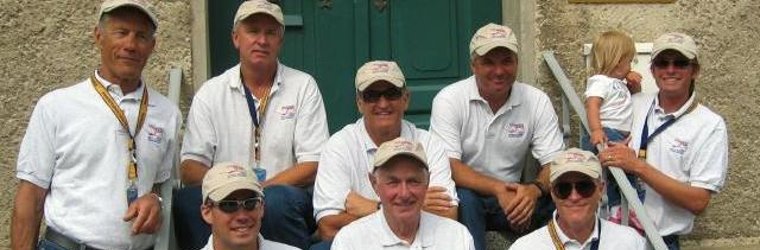
It was an OK but not a great day for the US team. In 15-Meter class, Gary Ittner fell into a hole and landed on the second leg. Karl Striedieck had a very late start after a relight, and did well to complete the task in the face of weakening conditions. In 18-Meter class, Doug Jacobs and Rick Walters decided to start early, which proved to be not the fastest choice, but they got home with reasonable distance and speeds. In the Open class, Heinz Weissenbuehler did 109 kph, good for 11th place; Garret Willat managed 100 kph.
Georg Theisinger (LT) of Germany had real trouble today. He released from tow in sinking air and soon found himself low and out of reach of the home field. He landed in an unharvested wheat field where, unfortunately, a mother deer and two fawns were hidden. The deer, alarmed by this strange bird rushing toward them, leapt to their feet and the mother was struck (and killed) by the wing. A groundloop ensued, which caused some damage to Georg’s ASW-27. By special dispensation (and not without some measure of controversy) he will be allowed to continue the contest in a different glider.
When gliders fly, they routinely smash bugs, whose remains collect on the leading edges of the wings and tail, degrading performance. At certain sites during certain times, the problem can be severe. Thus you can now buy “bugwipers” for your glider. These typically consist of spring-loaded devices that live at the root of each wing, connected to what are basically fishing reels. When the pilot notices an unacceptable collection of smashed bugs, he unwinds each reel which causes the bugwiper to spring open and, driven by airflow, travel along the wing dragging a fine wire across the leading edge. The theory is that this wire scrapes off most of the bug remains, and thus restores the smooth laminar flow that all glider pilots prefer. When the bugwiper has made its way near to the end of the wing, the pilot then reels it in, causing it to again stow itself at the wing root, ready for the next hour’s bug collection.
There are often complications: Sometimes bugwipers get hung up somewhere along the wing; sometimes they fall off entirely and trail behind until landing. Each of these disasters of course leads to more drag than bugs ever would have caused. Here at Lüsse, bugwipers are reckoned to be a necessary accessory, but thus far at WGC 2008 bugs have been tolerably scarce and today (no doubt in part due to strong winds) they seem to have been scarcely flying at all. Many pilots have removed their bugwipers, and many crews are hoping that these troublesome devices need not be re-attached during this contest.
I had a measure of ornithological success this morning, though I still haven't seen a Great Bustard. On a morning drive we spotted some large birds in a field, which proved to be Eurasian Cranes, with an appearance and voice similar to that of the Sandhill Crane. In the small town of Baitz (“Bites”), about 3 km north of the airfield, we also spotted a stork nest, with White Storks both perched and flying nearby. The elegant Red Kite is seen nearly every day, wheeling and soaring low over the airfield. Its flight style is reminiscent of the Swallow-tailed Kite routinely seen at the Senior Contest in Florida – though no bird ever hatched can hope to equal the in-flight grace of a Swallow-tailed Kite.
An interesting point at World Gliding Contests is that the official language is English. This causes some complications in a country whose native language is different (and more so in eastern Germany, where English-speakers seem not as common as in the west). We have found that at this contest the pilot briefings have been generally very good, though sometimes the accents are tolerably thick.
One complication is that the Germany word for “launch” is “start”, but at a glider contest it’s usually important to distinguish between launching (when you leave the ground) and starting (when you set out on your racing task). The precise meaning of announcements such as “First start is scheduled for 13:15” is not always obvious.
We also note that wind reports can be a bit quirky. When you are used to “Wind on the field is 290 degrees at 12 knots” it’s a bit strange to hear “… with 12 knots” or “ … from 12 knots”, though in this case the meaning is perfectly clear.
The Australian party at the Event Hangar was a big success this evening – that’s pretty well guaranteed at a soaring contest when you offer free beer, wine and grilled sausages. A dramatic sunset helped. Unfortunately, there proved to be no truth to the rumor that barbecued venison was a last-minute addition to the menu.

Thanks to Our Sponsors!
Monday, August 4, 2008
Afternoon report
We awoke to rain and gusty winds this morning, which convinced essentially everyone that we’d do no flying today. This apparently included the contest organizers, who had prepared no tasks for the morning pilot meeting. But, despite rain that drummed on the hangar roof as he spoke, the weatherman said we’d again have an afternoon window of weather suitable for racing. And he was right – at 2pm the launch is underway under beautiful cumulus clouds with bases near 5000’. Once again the sandy soil in this area gets credit for swallowing the rain and allowing good soaring without the typical 12- to 24-hour drying period.
But the wind is definitely a problem – it’s 20 knots on the ground, with gusts well above that. At cloudbase it’s at least 25 knots. The plentiful clouds show lots of streeting. Just how long this will last is a big question – the weatherman (who now has a good reputation for accuracy) says pilots should not expect much help after 5pm, and (no doubt for this reason) all classes have short turn-area tasks. There is less evidence of overdevelopment than we saw at this time yesterday, but I’d be surprised if this day remains trouble-free.
It appears I spoke a bit quickly about the excellent waterballast facilities here. Each day 130 gliders take on a total of something like 5200 gallons of water (that’s around 21 tons), all of which must flow a long ways through half-inch hoses. And when everyone is scrambling to prepare gliders for flight, it flows at a rather pitiful rate. The Ventus sailplane that I prepare each day takes around 45 gallons of water, which today required about 40 minutes to dribble out of the hose. I doubt there’s much help for this (though I have toyed with the idea of some “midnight engineering” in the form of restrictions placed in water taps upstream of ours).
Launches remain a concern. We were told that a couple more towplanes would be added to the fleet today, an acknowledgement that organizers concur with the notion that tows should proceed more rapidly. But today’s 18-Meter launch required around 40 minutes for 50 gliders, which is not much of an improvement.
But the wind is definitely a problem – it’s 20 knots on the ground, with gusts well above that. At cloudbase it’s at least 25 knots. The plentiful clouds show lots of streeting. Just how long this will last is a big question – the weatherman (who now has a good reputation for accuracy) says pilots should not expect much help after 5pm, and (no doubt for this reason) all classes have short turn-area tasks. There is less evidence of overdevelopment than we saw at this time yesterday, but I’d be surprised if this day remains trouble-free.
It appears I spoke a bit quickly about the excellent waterballast facilities here. Each day 130 gliders take on a total of something like 5200 gallons of water (that’s around 21 tons), all of which must flow a long ways through half-inch hoses. And when everyone is scrambling to prepare gliders for flight, it flows at a rather pitiful rate. The Ventus sailplane that I prepare each day takes around 45 gallons of water, which today required about 40 minutes to dribble out of the hose. I doubt there’s much help for this (though I have toyed with the idea of some “midnight engineering” in the form of restrictions placed in water taps upstream of ours).
Launches remain a concern. We were told that a couple more towplanes would be added to the fleet today, an acknowledgement that organizers concur with the notion that tows should proceed more rapidly. But today’s 18-Meter launch required around 40 minutes for 50 gliders, which is not much of an improvement.


Sunday, August 3, 2008
Evening report
The effect of today’s weather on pilots at the 30th World Gliding Championships had a lot to do with what class you were in, but it was certainly good day on which to get home (something more than a few of the world’s best failed to do).
Open class was first to launch and (as is typically the case) had the longest task – 341 km. Their long wings were just the thing for dealing with a sky that had some extensive dead areas caused by overdevelopment and spreadout of mid-level clouds. But speeds were far below those seen during the trouble-free weather of several days ago, and 10 pilots failed to get around. The winner was Steve Jones (110) of Great Britain, a master in difficult and changeable weather (of which every British pilot sees a great deal). US pilots Garret Willat (NV) and Heinz Weissenbuehler (HW) found – and dug themselves out of – several holes, finishing 20th and 22nd (and obviously glad to be back).
18-Meter class had the worst of it. Their first turnpoint was well to the west, where little sun was on the ground and soaring was grim at best. 34 pilots failed to complete the task; of these, nearly all came to earth on the first leg or shortly into the second. Because so many achieved less than 100km, the day was heavily devalued, with the winner receiving just 550 points. It’s a feature of WGC scoring that when many pilots fail to finish, not many speed points are awarded. Because of this, there was little separation among the scores of finishers – a “big tie” down to 10th place. US pilots Doug Jacobs (DJ) and Rick Walters (71) cooperated extensively and got around this difficult task; they finished 7th and 9th, less than 20 points out of first. Some big names were among the landouts, including recent champions Phil Jones (210) and Wolfgang Janowitsch (WO).
15-Meter class was last to launch and was given a turn-area task with just a 2-hour minimum time. WGC rules call for devaluation when the winner’s time on course is less than 3 hours, so well before any launch this was guaranteed to be a day worth far less than 1000 points. (As Gary Ittner put it, “A Regional task at a World Championship contest.”) This call may have been related to the expectation of a long launch time (see below) but it certainly did raise some eyebrows. Not surprisingly, the 15-Meter class had the best completion rate, with just 3 landouts. US pilots Karl Striedieck (VW) and Gary Ittner (VV) were 19th and 20th, around 90 points out of first.
In addition to the 15-Meter task, other controversies swirl around today’s flying. Some scores were obviously incorrect when first posted. Some of the problems may have had to do with incorrect start times and the failure of analysis software to properly detect engine runs (this is typically done with a microphone that records engine noise). Most of these seem to have been sorted out, though it’s a bit puzzling that such “teething” problems should remain after five practice days that included plenty of flying.
An issue that seems likely to cause strife involves the use of engines by 18-Meter class gliders. Originally, all gliders with engines were to have been permitted to use these in lieu of landing for a re-launch, the idea being that this is quicker and more efficient. But this was thought by some to be unfair, and an appeal was made to the organizers to require that all re-launches involve an actual landing on the airfield (since non-motorized are obliged to do this, and so incur the delay that this necessarily involves). The decision, announced this morning, was that Open class gliders may use their engines to avoid the need for a landing, but all others would have to land first.
Notwithstanding this announcement, it appears that several 18-Meter class pilots may have used their engines in flight – no doubt they missed or didn’t understand the rule change. The penalty for this is likely to be the loss of all their daily points, since the general rule is that a pilot is scored as if he had landed at the place where the engine was used. It’s a bit grim to start a big competition with a misunderstanding like this – perhaps there will be some way I haven’t thought of that this can be resolved fairly and with satisfaction to all.
There will also likely be some low-level controversy about the time it took to launch the fleet – about an hour and 45 minutes today, despite the use of a dozen tow planes and the presence of plenty of self-launching gliders. It seems that the performance of the Wilga towplanes used here varies a lot – some are quite strong, while others climb slowly with a glider on tow. A day like today, with a restricted “window” of good soaring weather, puts a premium on a fast and efficient launch operation. Based on recent World contests, I’d say that the 40 minutes achieved in 2003 in Poland counts as superb, an hour is good, and much longer than that is likely to be judged as deficient.
This morning we were told to expect rain by this evening, and a poor chance of flying tomorrow. But the evening sky was mostly clear and temperatures were close to ideal, so a large group settled in for dinner outdoors at the local castle/fortress (said to be 1000 years old) on a hill overlooking the town of Belzig. One poor German waiter had to contend with about 20 Brits (who are staying there) and 15 Americans. He did a commendable job, and we will likely return.
Open class was first to launch and (as is typically the case) had the longest task – 341 km. Their long wings were just the thing for dealing with a sky that had some extensive dead areas caused by overdevelopment and spreadout of mid-level clouds. But speeds were far below those seen during the trouble-free weather of several days ago, and 10 pilots failed to get around. The winner was Steve Jones (110) of Great Britain, a master in difficult and changeable weather (of which every British pilot sees a great deal). US pilots Garret Willat (NV) and Heinz Weissenbuehler (HW) found – and dug themselves out of – several holes, finishing 20th and 22nd (and obviously glad to be back).
18-Meter class had the worst of it. Their first turnpoint was well to the west, where little sun was on the ground and soaring was grim at best. 34 pilots failed to complete the task; of these, nearly all came to earth on the first leg or shortly into the second. Because so many achieved less than 100km, the day was heavily devalued, with the winner receiving just 550 points. It’s a feature of WGC scoring that when many pilots fail to finish, not many speed points are awarded. Because of this, there was little separation among the scores of finishers – a “big tie” down to 10th place. US pilots Doug Jacobs (DJ) and Rick Walters (71) cooperated extensively and got around this difficult task; they finished 7th and 9th, less than 20 points out of first. Some big names were among the landouts, including recent champions Phil Jones (210) and Wolfgang Janowitsch (WO).
15-Meter class was last to launch and was given a turn-area task with just a 2-hour minimum time. WGC rules call for devaluation when the winner’s time on course is less than 3 hours, so well before any launch this was guaranteed to be a day worth far less than 1000 points. (As Gary Ittner put it, “A Regional task at a World Championship contest.”) This call may have been related to the expectation of a long launch time (see below) but it certainly did raise some eyebrows. Not surprisingly, the 15-Meter class had the best completion rate, with just 3 landouts. US pilots Karl Striedieck (VW) and Gary Ittner (VV) were 19th and 20th, around 90 points out of first.
In addition to the 15-Meter task, other controversies swirl around today’s flying. Some scores were obviously incorrect when first posted. Some of the problems may have had to do with incorrect start times and the failure of analysis software to properly detect engine runs (this is typically done with a microphone that records engine noise). Most of these seem to have been sorted out, though it’s a bit puzzling that such “teething” problems should remain after five practice days that included plenty of flying.
An issue that seems likely to cause strife involves the use of engines by 18-Meter class gliders. Originally, all gliders with engines were to have been permitted to use these in lieu of landing for a re-launch, the idea being that this is quicker and more efficient. But this was thought by some to be unfair, and an appeal was made to the organizers to require that all re-launches involve an actual landing on the airfield (since non-motorized are obliged to do this, and so incur the delay that this necessarily involves). The decision, announced this morning, was that Open class gliders may use their engines to avoid the need for a landing, but all others would have to land first.
Notwithstanding this announcement, it appears that several 18-Meter class pilots may have used their engines in flight – no doubt they missed or didn’t understand the rule change. The penalty for this is likely to be the loss of all their daily points, since the general rule is that a pilot is scored as if he had landed at the place where the engine was used. It’s a bit grim to start a big competition with a misunderstanding like this – perhaps there will be some way I haven’t thought of that this can be resolved fairly and with satisfaction to all.
There will also likely be some low-level controversy about the time it took to launch the fleet – about an hour and 45 minutes today, despite the use of a dozen tow planes and the presence of plenty of self-launching gliders. It seems that the performance of the Wilga towplanes used here varies a lot – some are quite strong, while others climb slowly with a glider on tow. A day like today, with a restricted “window” of good soaring weather, puts a premium on a fast and efficient launch operation. Based on recent World contests, I’d say that the 40 minutes achieved in 2003 in Poland counts as superb, an hour is good, and much longer than that is likely to be judged as deficient.
This morning we were told to expect rain by this evening, and a poor chance of flying tomorrow. But the evening sky was mostly clear and temperatures were close to ideal, so a large group settled in for dinner outdoors at the local castle/fortress (said to be 1000 years old) on a hill overlooking the town of Belzig. One poor German waiter had to contend with about 20 Brits (who are staying there) and 15 Americans. He did a commendable job, and we will likely return.
Afternoon report
It’s the first official competition day at Lüsse, and the weather is much more troublesome than anything seen during the practice period. We have cooler weather with lots of low and mid-level clouds, obviously tending toward overdevelopment. Tasks are short, in an attempt to take advantage of what the weatherman described as a narrow window of soarable weather between two weak fronts.
Despite the rain of two days ago (and more last night) the field is in excellent shape. Today we gridded at the east end for the first time, in honor of a 15 - 20 knot westerly wind. The launch began at 11:45, with a dozen Wilga (“Thrush”, in Polish) towplanes taxiing out to begin their work. These are decidedly ugly aircraft with a high wing and a radial engine. Their drag is obviously considerable – enough that their preferred speed is just a bit lower than the pilot of a fully ballasted glider would be entirely happy about. About the only streamlining on a Wilga is some rather optimistic fairing of the gear legs – about like painting the toenails of a pig. But they are common in eastern Europe and generally do a fine job.
It was soon clear that the launch would be challenging. A couple of Open-class gliders were seen doing “aerial relights” by deploying their stow-away engines (which the majority of gliders in this class carry). The 18-Meter class was next and had the misfortune of being towed downwind of the field to an area of the sky with nothing but dead-looking clouds. Some of this class managed to escape to more promising areas, but many got low and about 8 had to land and re-launch – aerial re-lights are not allowed in this class (though we thought we might have seen a couple of gliders flouting this rule).
Among the re-launchers was Rick Walters (71), who was unable to get from one dying cloud to the next working one. But his landing was particularly well timed, and he was soon up again and this time had little trouble connecting with good lift and joining teammate Doug Jacobs (DJ). By contrast, we saw a number of pilots spend as much as 20 to 30 minutes grinding around at low altitude, from which few were able to escape. One pilot landed twice, and at this contest three launches is the maximum for one day – if he lands again, he’s done.
A World Gliding Competition is a marathon, not a sprint, and there are lots of ways that pilots can fall by the wayside. This morning I noticed a new-looking crew car with a nasty dent in its tailgate; further investigation disclosed some white marks that were almost certainly gelcoat. Backing your car into your wingtip is one of many ways to cause yourself trouble.
We were gratified at this morning’s pilot briefing to hear Garret Willat (NV) acknowledged as the winner of the Open class task on the final practice day. Give credit also to Mike Robison who flies in the back seat of their ASH-25. They are cooperating well with Heinz Weissenbuehler (HW – Nimbus 4) which seems to bode well for both.
As I write this, all six US aircraft are up and started – no mean feat on this troublesome-looking day. The sky to the southwest is again tending toward overdevelopment, and all three classes’ tasks pass through that area. It’s looking like a day that will demand plenty of detours and “gear changing”. I’ll be back with a full report this evening.
Despite the rain of two days ago (and more last night) the field is in excellent shape. Today we gridded at the east end for the first time, in honor of a 15 - 20 knot westerly wind. The launch began at 11:45, with a dozen Wilga (“Thrush”, in Polish) towplanes taxiing out to begin their work. These are decidedly ugly aircraft with a high wing and a radial engine. Their drag is obviously considerable – enough that their preferred speed is just a bit lower than the pilot of a fully ballasted glider would be entirely happy about. About the only streamlining on a Wilga is some rather optimistic fairing of the gear legs – about like painting the toenails of a pig. But they are common in eastern Europe and generally do a fine job.
It was soon clear that the launch would be challenging. A couple of Open-class gliders were seen doing “aerial relights” by deploying their stow-away engines (which the majority of gliders in this class carry). The 18-Meter class was next and had the misfortune of being towed downwind of the field to an area of the sky with nothing but dead-looking clouds. Some of this class managed to escape to more promising areas, but many got low and about 8 had to land and re-launch – aerial re-lights are not allowed in this class (though we thought we might have seen a couple of gliders flouting this rule).
Among the re-launchers was Rick Walters (71), who was unable to get from one dying cloud to the next working one. But his landing was particularly well timed, and he was soon up again and this time had little trouble connecting with good lift and joining teammate Doug Jacobs (DJ). By contrast, we saw a number of pilots spend as much as 20 to 30 minutes grinding around at low altitude, from which few were able to escape. One pilot landed twice, and at this contest three launches is the maximum for one day – if he lands again, he’s done.
A World Gliding Competition is a marathon, not a sprint, and there are lots of ways that pilots can fall by the wayside. This morning I noticed a new-looking crew car with a nasty dent in its tailgate; further investigation disclosed some white marks that were almost certainly gelcoat. Backing your car into your wingtip is one of many ways to cause yourself trouble.
We were gratified at this morning’s pilot briefing to hear Garret Willat (NV) acknowledged as the winner of the Open class task on the final practice day. Give credit also to Mike Robison who flies in the back seat of their ASH-25. They are cooperating well with Heinz Weissenbuehler (HW – Nimbus 4) which seems to bode well for both.
As I write this, all six US aircraft are up and started – no mean feat on this troublesome-looking day. The sky to the southwest is again tending toward overdevelopment, and all three classes’ tasks pass through that area. It’s looking like a day that will demand plenty of detours and “gear changing”. I’ll be back with a full report this evening.
Saturday, August 2, 2008
The overnight rain at Lüsse was impressive (more than 2 inches, I’d guess) but the ground seems to have lived up to its reputation: the field (which last night had considerable standing water, and a certain number of drowned mice) was dry enough this morning to support normal automobile traffic. Plenty of low cloud was in evidence; at the morning pilot meeting we were told to expect clearing by late afternoon, in time for the opening ceremonies. Many pilots were skeptical of this, but it proved an accurate forecast.
This pilot briefing was the first “formal” one of the contest, at which pilot attendance was mandatory and essential information was promulgated. The first order of business was to introduce 130 pilots from 34 countries (a record at international gliding competition, no doubt due in part to the fragmentation of eastern Europe). This took a good while. We then were given a briefing on certain local rules which until now had not been precisely decided on.
One involved the height control for starts (which most pilots would probably consider basic enough that it should have been nailed down 6 months ago). The plan is to impose a maximum height limit. The problem with this is that when pilots can climb above that height they will do so, and then dive down (typically at dangerous speeds) to fall within the limit while retaining maximum energy. So the plan had been to measure speeds, which would be limited to 160 kph (about 100 mph). But this is not easy to do from a record of positions (as is produced by the GPS flight loggers that all pilots carry). After much discussion and wrangling, it was decided that the best scheme is to restrict pilots to a certain altitude for the two minutes prior to any start. The only question now is whether the scoring software is fully capable of imposing such a limit (this should certainly have been tested during the practice period). We hope for the best.
A welcome announcement was that an arrangement has been secured with Polish airspace authorities whereby gliders from this contest can fly into Poland under exactly the same rules as apply to German airspace. This is certainly welcome, and only in the past few years would this have been possible. We all hope a task will soon be possible that takes advantage of this cross-border agreement.
I’ve been asked to say a bit more about airspace restrictions here. The contest airspace database contains the description of all possible airspace that could be closed to glider flying (which is a great deal). Each day, task sheets include a list of the airspace areas that are not closed; this usually runs to at least a half-dozen such areas – so the actual restrictions are usually a bit less severe than they might be. The maps on the daily task sheets undertake to depict just the airspace that is “hot” that day (though not the altitude limits, which vary wildly). But pilots will need to be very alert – it seems normal here that tasks are set so they pass quite close to troublesome airspace and past experience suggests that this approach will reliably yield violations, sometimes from very experienced pilots. Penalties are severe: the first offense causes a pilot to be scored as if he had landed at the point of the violation; the penalty for the second offense is a score of zero for the day.
Another topic at the pilot briefing was finish procedures. There are two possibilities: a “speed finish” which applies when a glider has enough energy to cross the finish line, then pull up and fly a pattern to a landing; and a “direct finish” when a pilot lands straight-in, without a pattern. The discussions seem to presume that the two will be about equally common, but this appears naïve to me. Gaining the extra energy necessary for a speed finish takes time, and successful sailplane racing is about saving time. So (especially with an 11,000 ft airfield to aim for) most pilots can be expected to choose the direct finish on most days.
At Lüsse, direct finishers have been instructed to land on the far side of the field, and to roll as far as they can – to the end of the airfield, if possible. This is all very well, but on this giant airfield it means that crews who wish to reach their pilots may have to drive a couple of miles to do so, and then an equal distance (with glider in tow) back to the trailer for disassembly. A pilot who lacks the energy to roll the end of the field will necessarily stop in the middle of the field, creating a temptation for the crew to drive across the active runway. I’m not the only one who’s skeptical that this scheme will work smoothly though 14 contest days.
This afternoon’s Opening Ceremony seemed to go off well. I can’t say for sure, because although I was there, crews were separated from pilots early in the process, and were mostly unable to get close to the action. We boarded buses at the airfield which took us to the Belzig town square. We arrived about an hour before the official start of events, but there was already a rock & roll band on stage (US music is undeniably popular here, if not always performed astonishingly well), a host of food and beer vendors in operation, and a substantial crowd of Belzig locals present (and occupying all available seating). Weather was excellent – sun just breaking out from behind mid-level clouds, with temperatures in the mid-seventies.
US Team crews settled in on the northwest side of the square, a good ways from the stage (where it appeared that VIPs, including former and current World Soaring Champions, were seated) but close to one of the beer and wine concessions. We heard occasional noise from the stage – no doubt certain politicians were giving speeches and at one point it seemed likely that current World Champions were being interviewed. But our involvement was limited to the hoisting of a succession of beers and a general foggy seconding of what seemed to be a friendly and approving mood. Eventually it ended and some of us retired to a commendable Italian restaurant. We thus believe that the 30th World Gliding Championships have been declared open and active.
I must note that yesterday’s final practice task yielded a first-place finish for US Pilot Garret Willat and back-seater Mike Robison in Open class. They guided their ASH-25 around a 262 km task at 123 kph. They did a particularly good job on their return home from the east, where overdevlopment and rain showers slowed many of their competitors.
This pilot briefing was the first “formal” one of the contest, at which pilot attendance was mandatory and essential information was promulgated. The first order of business was to introduce 130 pilots from 34 countries (a record at international gliding competition, no doubt due in part to the fragmentation of eastern Europe). This took a good while. We then were given a briefing on certain local rules which until now had not been precisely decided on.
One involved the height control for starts (which most pilots would probably consider basic enough that it should have been nailed down 6 months ago). The plan is to impose a maximum height limit. The problem with this is that when pilots can climb above that height they will do so, and then dive down (typically at dangerous speeds) to fall within the limit while retaining maximum energy. So the plan had been to measure speeds, which would be limited to 160 kph (about 100 mph). But this is not easy to do from a record of positions (as is produced by the GPS flight loggers that all pilots carry). After much discussion and wrangling, it was decided that the best scheme is to restrict pilots to a certain altitude for the two minutes prior to any start. The only question now is whether the scoring software is fully capable of imposing such a limit (this should certainly have been tested during the practice period). We hope for the best.
A welcome announcement was that an arrangement has been secured with Polish airspace authorities whereby gliders from this contest can fly into Poland under exactly the same rules as apply to German airspace. This is certainly welcome, and only in the past few years would this have been possible. We all hope a task will soon be possible that takes advantage of this cross-border agreement.
I’ve been asked to say a bit more about airspace restrictions here. The contest airspace database contains the description of all possible airspace that could be closed to glider flying (which is a great deal). Each day, task sheets include a list of the airspace areas that are not closed; this usually runs to at least a half-dozen such areas – so the actual restrictions are usually a bit less severe than they might be. The maps on the daily task sheets undertake to depict just the airspace that is “hot” that day (though not the altitude limits, which vary wildly). But pilots will need to be very alert – it seems normal here that tasks are set so they pass quite close to troublesome airspace and past experience suggests that this approach will reliably yield violations, sometimes from very experienced pilots. Penalties are severe: the first offense causes a pilot to be scored as if he had landed at the point of the violation; the penalty for the second offense is a score of zero for the day.
Another topic at the pilot briefing was finish procedures. There are two possibilities: a “speed finish” which applies when a glider has enough energy to cross the finish line, then pull up and fly a pattern to a landing; and a “direct finish” when a pilot lands straight-in, without a pattern. The discussions seem to presume that the two will be about equally common, but this appears naïve to me. Gaining the extra energy necessary for a speed finish takes time, and successful sailplane racing is about saving time. So (especially with an 11,000 ft airfield to aim for) most pilots can be expected to choose the direct finish on most days.
At Lüsse, direct finishers have been instructed to land on the far side of the field, and to roll as far as they can – to the end of the airfield, if possible. This is all very well, but on this giant airfield it means that crews who wish to reach their pilots may have to drive a couple of miles to do so, and then an equal distance (with glider in tow) back to the trailer for disassembly. A pilot who lacks the energy to roll the end of the field will necessarily stop in the middle of the field, creating a temptation for the crew to drive across the active runway. I’m not the only one who’s skeptical that this scheme will work smoothly though 14 contest days.
This afternoon’s Opening Ceremony seemed to go off well. I can’t say for sure, because although I was there, crews were separated from pilots early in the process, and were mostly unable to get close to the action. We boarded buses at the airfield which took us to the Belzig town square. We arrived about an hour before the official start of events, but there was already a rock & roll band on stage (US music is undeniably popular here, if not always performed astonishingly well), a host of food and beer vendors in operation, and a substantial crowd of Belzig locals present (and occupying all available seating). Weather was excellent – sun just breaking out from behind mid-level clouds, with temperatures in the mid-seventies.
US Team crews settled in on the northwest side of the square, a good ways from the stage (where it appeared that VIPs, including former and current World Soaring Champions, were seated) but close to one of the beer and wine concessions. We heard occasional noise from the stage – no doubt certain politicians were giving speeches and at one point it seemed likely that current World Champions were being interviewed. But our involvement was limited to the hoisting of a succession of beers and a general foggy seconding of what seemed to be a friendly and approving mood. Eventually it ended and some of us retired to a commendable Italian restaurant. We thus believe that the 30th World Gliding Championships have been declared open and active.
I must note that yesterday’s final practice task yielded a first-place finish for US Pilot Garret Willat and back-seater Mike Robison in Open class. They guided their ASH-25 around a 262 km task at 123 kph. They did a particularly good job on their return home from the east, where overdevlopment and rain showers slowed many of their competitors.
Friday, August 1, 2008
The practice period at Lüsse ended with a day that was about 1 part bang and 3 parts whimper. Despite various forecasts calling for overnight gloom, we awoke to another cool morning with clear skies. At the morning pilot meeting we heard predictions of good soaring conditions ending early. Short tasks were set.
The problem was a front marching in from the west, from which we were told to expect rain, strong wind, and possibly hail. In the face of this, at least half the pilots decided not to fly. Those who did found the forecast was reasonably accurate, and that an early start (which nearly everyone used) was sufficient to get home, mostly with reasonable speeds (albeit generally slower than on previous tasks here).
The predicted savage late-afternoon weather didn’t materialize. There seems to be an effect at Lüsse which causes troublesome weather to pass either south or north of the field, but which often spares the area within 15 km of home. This claim is a bit puzzling to newcomers, as there is nothing in the local terrain that looks anywhere near prominent enough to control incoming weather, but we have been told of this and we may have seen an example today. For whatever reason, the incoming front produced afternoon thunderstorms nearby, but not at the field itself.
Since I’m reporting on a gliding contest I probably shouldn’t say this, but we could use some rain here. The area is seriously dry. Small ponds are nothing but baked mud, and we see field fires every day. The wheat field just north of the airfield burned again today. This was much less dramatic than the fire of 3 days ago, but it still managed to get everyone’s attention. The local fire department, no doubt now sensitized to the problem, was on the scene rapidly, though there was again little they could do. There is no further danger to the contest – all the wheat anywhere near the airfield has been turned to ashes.
We are told that this area is one that can handle rain well – the soil is quite sandy and unusually well drained. Apparently, good soaring can be had within a few hours of a significant rainfall.
Tomorrow will be a non-flying day. The big event will be the Opening Ceremony, scheduled for 4pm in the town square of Belzig, about 4 km from the airfield. We don’t yet know quite what to expect from this. Such events are usually held on the airfield itself, where pilots and crews dressed in their team uniforms march in formation (or at least attempt to), listen to speeches by local politicians (these are often not translated, for which most of the assembled are grateful) and then watch an airshow of varying quality. Here, the airshow will take place about halfway through the contest, making tomorrow’s events harder to predict. From having visited it we do know that squeezing everyone into the Belzig town square could get interesting.
Further to the subject of restricted airspace, I must mention the Great Bustard, a giant bird with the appealing latin name of Otis Tarda. The male of this species is among the heaviest birds in the world actually capable of flight. This is important to WGC 2008 because a bird sanctuary devoted to preserving breeding habitat for Bustards is located just north of the Lüsse airfield. Flight below 1800’ there will lead to a severe penalty, and pilots of motorized gliders must not start their engines while over this area, regardless of height (the Bustard is apparently held by wildlife authorities to be particularly sensitive to the presence of large flying objects overhead). I’ve been out early on several mornings hoping to spot a Great Bustard. Karl Striedieck has seen several on his morning runs, but I’m still looking.
As is my habit, I’m writing this report from the US Team headquarters hut. It’s 10:30 pm. Perhaps in response to my opening paragraphs, the skies have opened up here and heavy rain is lashing the airfield. I expect the airfield campgrounds (always well populated at these events) are suffering just now. I will likely be soaked before reaching my car, but I’m going to end this report and make a run for it. (Heinz Weissenbuehler has just appeared to inform me that water is standing 5 inches deep on the field – that theory of how the ground drains quickly will apparently now be tested.)
The problem was a front marching in from the west, from which we were told to expect rain, strong wind, and possibly hail. In the face of this, at least half the pilots decided not to fly. Those who did found the forecast was reasonably accurate, and that an early start (which nearly everyone used) was sufficient to get home, mostly with reasonable speeds (albeit generally slower than on previous tasks here).
The predicted savage late-afternoon weather didn’t materialize. There seems to be an effect at Lüsse which causes troublesome weather to pass either south or north of the field, but which often spares the area within 15 km of home. This claim is a bit puzzling to newcomers, as there is nothing in the local terrain that looks anywhere near prominent enough to control incoming weather, but we have been told of this and we may have seen an example today. For whatever reason, the incoming front produced afternoon thunderstorms nearby, but not at the field itself.
Since I’m reporting on a gliding contest I probably shouldn’t say this, but we could use some rain here. The area is seriously dry. Small ponds are nothing but baked mud, and we see field fires every day. The wheat field just north of the airfield burned again today. This was much less dramatic than the fire of 3 days ago, but it still managed to get everyone’s attention. The local fire department, no doubt now sensitized to the problem, was on the scene rapidly, though there was again little they could do. There is no further danger to the contest – all the wheat anywhere near the airfield has been turned to ashes.
We are told that this area is one that can handle rain well – the soil is quite sandy and unusually well drained. Apparently, good soaring can be had within a few hours of a significant rainfall.
Tomorrow will be a non-flying day. The big event will be the Opening Ceremony, scheduled for 4pm in the town square of Belzig, about 4 km from the airfield. We don’t yet know quite what to expect from this. Such events are usually held on the airfield itself, where pilots and crews dressed in their team uniforms march in formation (or at least attempt to), listen to speeches by local politicians (these are often not translated, for which most of the assembled are grateful) and then watch an airshow of varying quality. Here, the airshow will take place about halfway through the contest, making tomorrow’s events harder to predict. From having visited it we do know that squeezing everyone into the Belzig town square could get interesting.
Further to the subject of restricted airspace, I must mention the Great Bustard, a giant bird with the appealing latin name of Otis Tarda. The male of this species is among the heaviest birds in the world actually capable of flight. This is important to WGC 2008 because a bird sanctuary devoted to preserving breeding habitat for Bustards is located just north of the Lüsse airfield. Flight below 1800’ there will lead to a severe penalty, and pilots of motorized gliders must not start their engines while over this area, regardless of height (the Bustard is apparently held by wildlife authorities to be particularly sensitive to the presence of large flying objects overhead). I’ve been out early on several mornings hoping to spot a Great Bustard. Karl Striedieck has seen several on his morning runs, but I’m still looking.
As is my habit, I’m writing this report from the US Team headquarters hut. It’s 10:30 pm. Perhaps in response to my opening paragraphs, the skies have opened up here and heavy rain is lashing the airfield. I expect the airfield campgrounds (always well populated at these events) are suffering just now. I will likely be soaked before reaching my car, but I’m going to end this report and make a run for it. (Heinz Weissenbuehler has just appeared to inform me that water is standing 5 inches deep on the field – that theory of how the ground drains quickly will apparently now be tested.)
Thursday, July 31, 2008
The third official practice day at Lüsse saw pilots and crews return to a racing state of mind. A weak cold front passed yesterday; this morning we had what we have come to expect: clear skies and cool air. At the morning pilot briefing the weatherman seemed a bit equivocal about the day’s prospects, and the tasks were commensurate: a Turn Area task of around 320 km for 15-Meter and 18-Meter classes, and an Assigned task of 344 km for the Open class. The day stayed blue until noon, so it was easy to believe conditions would not match what we’d seen earlier in the week and that these short tasks were about right.
But at 2pm a very different face of things was seen. Sparse cumulus were evident, and their bases looked impressively high. On course, pilots reported mostly trouble-free flying with occasional 7-knot climbs to over 8000’. Winning speeds were notable: 144 kph in Open class, 140 in 18-Meter class, and 138 in 15-Meter. That’s about as good as it gets.
In view of these conditions and the resulting speeds, tasks were far shorter than they should have been. This may have had something to do with expectations for the launch operation, which today took around 2 hours and 25 minutes to put something less than the full WGC 2008 fleet into the air. Contrast this with WGC 2003 at Leszno, Poland where 128 gliders were launched in as little as 40 minutes, and you can see that some work is needed here. We are told that an additional 6 towplanes will be present when official competition starts; they will certainly be welcome.
It’s worth noting that during five days of first-rate soaring, the wind at Lüsse has consistently been from the east. We are told that this is a normal pattern for this time of year here. But there can be few places in the world where an east wind is associated with good soaring weather,
The normally efficient morning pilot meeting encountered some snags today. The first was minor, as the weatherman struggled to get his Powerpoint presentation to appear on the giant screen (this nearly always proves challenging). Then, questions were raised about the task for 18-Meter and 15-Meter classes, which originally specified a maximum distance that looked to be easily achievable in the specified minimum time (3 hours), a situation that leads to a big tie on the scoresheet and thus a more or less meaningless task. The response was to reduce the minimum time to 2:30, which made a limited amount of sense but raised the question as to whether future task changes would be initiated by public outcry (pilots would much prefer the notion – at times perhaps illusory – that task setters understand the weather, pilots’ capabilities and the rules, and can set tasks that don’t need last-minute adjustment).
Other slightly discordant notes were struck by the absence of any grid list (we are still on the do-it-yourself system), the announcement that crews would have to both run the wingtip during launch (expected) and hook up the tow rope (almost always done by contest staff). In the event, hookups were provided.
A source of some controversy has been the requirement that all gliders carry large adhesive signs bearing the name of the contest sponsor, Lufthansa. On the one hand, it’s highly commendable that the contest was able to secure this sponsorship, and that Lufthansa was willing to offer it. On the other, pilots are averse to putting much of anything on their gliders not directly related to aviation, and especially if it has a detectable edge (about 0.008” in this case). The pill in this case can be swallowed because the requirement falls equally on all pilots (though it was notable that only about 80% had the stickers affixed as of today’s launch). A complication is the news that Lufthansa employees are now apparently on strike. A rumor is circulating to the effect that one of the “sponsor events” was to have been a party catered by Lufthansa, so we may now be on our own resources for that.
The big event this evening was a party hosted by the British, Dutch and Italian teams. I arrived a bit late and was surprised to find that some food still remained (the ability of the pilots, crews and hangers-on associated with 130+ gliders to suck down food and drink is something that must be seen to be believed). The Dutch national color is orange, and the Dutch team members were serving a fiery orange liqueur whose color perfectly matched their T-shirts. They apparently also stocked the rest rooms with orange toilet paper (much of which was quickly seized by souvenir hunters). Paul Weeden and Gary Ittner have just stuck their heads in the window of the US Team hut (where I compose these reports) to inform me of this, and the fact that it’s late and I’m one of the few relatively sober souls left on the airfield. So I will conclude this report and head for bed.
But at 2pm a very different face of things was seen. Sparse cumulus were evident, and their bases looked impressively high. On course, pilots reported mostly trouble-free flying with occasional 7-knot climbs to over 8000’. Winning speeds were notable: 144 kph in Open class, 140 in 18-Meter class, and 138 in 15-Meter. That’s about as good as it gets.
In view of these conditions and the resulting speeds, tasks were far shorter than they should have been. This may have had something to do with expectations for the launch operation, which today took around 2 hours and 25 minutes to put something less than the full WGC 2008 fleet into the air. Contrast this with WGC 2003 at Leszno, Poland where 128 gliders were launched in as little as 40 minutes, and you can see that some work is needed here. We are told that an additional 6 towplanes will be present when official competition starts; they will certainly be welcome.
It’s worth noting that during five days of first-rate soaring, the wind at Lüsse has consistently been from the east. We are told that this is a normal pattern for this time of year here. But there can be few places in the world where an east wind is associated with good soaring weather,
The normally efficient morning pilot meeting encountered some snags today. The first was minor, as the weatherman struggled to get his Powerpoint presentation to appear on the giant screen (this nearly always proves challenging). Then, questions were raised about the task for 18-Meter and 15-Meter classes, which originally specified a maximum distance that looked to be easily achievable in the specified minimum time (3 hours), a situation that leads to a big tie on the scoresheet and thus a more or less meaningless task. The response was to reduce the minimum time to 2:30, which made a limited amount of sense but raised the question as to whether future task changes would be initiated by public outcry (pilots would much prefer the notion – at times perhaps illusory – that task setters understand the weather, pilots’ capabilities and the rules, and can set tasks that don’t need last-minute adjustment).
Other slightly discordant notes were struck by the absence of any grid list (we are still on the do-it-yourself system), the announcement that crews would have to both run the wingtip during launch (expected) and hook up the tow rope (almost always done by contest staff). In the event, hookups were provided.
A source of some controversy has been the requirement that all gliders carry large adhesive signs bearing the name of the contest sponsor, Lufthansa. On the one hand, it’s highly commendable that the contest was able to secure this sponsorship, and that Lufthansa was willing to offer it. On the other, pilots are averse to putting much of anything on their gliders not directly related to aviation, and especially if it has a detectable edge (about 0.008” in this case). The pill in this case can be swallowed because the requirement falls equally on all pilots (though it was notable that only about 80% had the stickers affixed as of today’s launch). A complication is the news that Lufthansa employees are now apparently on strike. A rumor is circulating to the effect that one of the “sponsor events” was to have been a party catered by Lufthansa, so we may now be on our own resources for that.
The big event this evening was a party hosted by the British, Dutch and Italian teams. I arrived a bit late and was surprised to find that some food still remained (the ability of the pilots, crews and hangers-on associated with 130+ gliders to suck down food and drink is something that must be seen to be believed). The Dutch national color is orange, and the Dutch team members were serving a fiery orange liqueur whose color perfectly matched their T-shirts. They apparently also stocked the rest rooms with orange toilet paper (much of which was quickly seized by souvenir hunters). Paul Weeden and Gary Ittner have just stuck their heads in the window of the US Team hut (where I compose these reports) to inform me of this, and the fact that it’s late and I’m one of the few relatively sober souls left on the airfield. So I will conclude this report and head for bed.
Wednesday, July 30, 2008
July 30
The second official practice day of the 30th World Gliding Championships was a rather quiet one. A weak cold front marched westward into eastern Germany last night, bringing low cloud and just a touch of rain. At the morning pilot briefing the weatherman held out some hope for late-afternoon flying, but after several days of excellent soaring weather few pilots seemed interested and at 2:30 pm the day’s task was canceled. Naturally, skies began to clear about then, and by 4:00 it was sunny with even a few cumulus clouds. But very few launches were seen – it was by general consensus a day for fettling rather than flying.
Nor did we have anything to match the excitement of yesterday’s field fire. The same combine was at work harvesting wheat just northwest of the airfield, this time without complications. One type of beer available locally is “Weissbier”, made from wheat. Most such are light, but a few are dark; we reckoned that the burned field could possibly contribute a very dark variety.
Perhaps 60% of the registered pilots chose to fly yesterday’s turn-area task. Winning speeds were close to my prediction of 130 kph. No one puts a great deal of stock in practice task results, but it was certainly a good day for the Brits (easily the most successful country in recent international soaring competition), who were first in all three classes. Team USA did well, with a third in Open class, third in 18-Meter class and sixth in 15-Meter class.
We also had one of the only landouts: Karl Striedieck found a hole on the final leg and landed (in a typically excellent field) about 50 km southeast of home. He caused a bit of fuss for the local police, who calmed down (and were actually quite helpful) when given the explanation for the “plane crash” – apparently, eastern Germany is a bit less used to soaring than the western areas.
As most who follow international soaring competition know, this is the first year that Standard class is not competing alongside the flapped classes (15-Meter, 18-Meter and Open). The non-flapped World Championships were held in Rieti, Italy a few weeks ago. There is some sense that this is a demotion for Standard class. Many pilots wonder about the future of classes and the plans of the often inscrutable IGC (International Gliding Commission). It seems to be a common belief that one or more classes are in line for extermination by The Powers That Be. One might well be the World Class, which has never achieved a strong level of participation. Another is thought to be either 15-Meter or Standard class; the 15-Meter class is believed by some to be the more likely, since its performance is reasonably close to that of the burgeoning 18-Meter class. Others say that the neck of the Standard class is on the block, and point to its exile from this contest as evidence.
It’s significant that the newest class – 18-Meter – is also the one with the most entries here. Despite a non-trivial increment in cost, it appears that pilots are forsaking 50-foot wingspans in favor of 60 feet. Doug Jacobs and I were just a few days ago at the factory taking delivery of his new 18-Meter Ventus 2cxa; we were told that Schempp-Hirth is building gliders about as fast as they can, and that almost all of them are capable of wingspans of 18 meters or more.
Part of the reason is the popularity of stow-away engines (both self-launching & sustainers) and the fact that the weight of an engine is much more easily borne by 18 meters of wing. Another factor is certainly improvements in handling. As I learned in a flight with Doug from the Hahnweide to the Black Forest and back (in a superb Ventus loaned by Biggo Berger), a modern 18-meter glider is a very attractive combination of Open-class performance of just a few years ago combined with 15-meter handling. I’d recommend you NOT fly one of these gliders unless you can afford to write a rather big check (as you’ll almost certainly be tempted to do shortly after landing).
That leads to the topic of the dollar-euro exchange rate, which is really quite savage just now. At 1:1, things would be a serious bargain in Europe; $1.15 - 1.20 to the euro would make things about even. But the current rate is around $1.58, which is vicious. Consider that at Lüsse a tow to around 2000’ costs 50 euro, which equates to $79 (!). The only sensible response is to ignore the brutal cost and simply enjoy the chance to be here.
Nor did we have anything to match the excitement of yesterday’s field fire. The same combine was at work harvesting wheat just northwest of the airfield, this time without complications. One type of beer available locally is “Weissbier”, made from wheat. Most such are light, but a few are dark; we reckoned that the burned field could possibly contribute a very dark variety.
Perhaps 60% of the registered pilots chose to fly yesterday’s turn-area task. Winning speeds were close to my prediction of 130 kph. No one puts a great deal of stock in practice task results, but it was certainly a good day for the Brits (easily the most successful country in recent international soaring competition), who were first in all three classes. Team USA did well, with a third in Open class, third in 18-Meter class and sixth in 15-Meter class.
We also had one of the only landouts: Karl Striedieck found a hole on the final leg and landed (in a typically excellent field) about 50 km southeast of home. He caused a bit of fuss for the local police, who calmed down (and were actually quite helpful) when given the explanation for the “plane crash” – apparently, eastern Germany is a bit less used to soaring than the western areas.
As most who follow international soaring competition know, this is the first year that Standard class is not competing alongside the flapped classes (15-Meter, 18-Meter and Open). The non-flapped World Championships were held in Rieti, Italy a few weeks ago. There is some sense that this is a demotion for Standard class. Many pilots wonder about the future of classes and the plans of the often inscrutable IGC (International Gliding Commission). It seems to be a common belief that one or more classes are in line for extermination by The Powers That Be. One might well be the World Class, which has never achieved a strong level of participation. Another is thought to be either 15-Meter or Standard class; the 15-Meter class is believed by some to be the more likely, since its performance is reasonably close to that of the burgeoning 18-Meter class. Others say that the neck of the Standard class is on the block, and point to its exile from this contest as evidence.
It’s significant that the newest class – 18-Meter – is also the one with the most entries here. Despite a non-trivial increment in cost, it appears that pilots are forsaking 50-foot wingspans in favor of 60 feet. Doug Jacobs and I were just a few days ago at the factory taking delivery of his new 18-Meter Ventus 2cxa; we were told that Schempp-Hirth is building gliders about as fast as they can, and that almost all of them are capable of wingspans of 18 meters or more.
Part of the reason is the popularity of stow-away engines (both self-launching & sustainers) and the fact that the weight of an engine is much more easily borne by 18 meters of wing. Another factor is certainly improvements in handling. As I learned in a flight with Doug from the Hahnweide to the Black Forest and back (in a superb Ventus loaned by Biggo Berger), a modern 18-meter glider is a very attractive combination of Open-class performance of just a few years ago combined with 15-meter handling. I’d recommend you NOT fly one of these gliders unless you can afford to write a rather big check (as you’ll almost certainly be tempted to do shortly after landing).
That leads to the topic of the dollar-euro exchange rate, which is really quite savage just now. At 1:1, things would be a serious bargain in Europe; $1.15 - 1.20 to the euro would make things about even. But the current rate is around $1.58, which is vicious. Consider that at Lüsse a tow to around 2000’ costs 50 euro, which equates to $79 (!). The only sensible response is to ignore the brutal cost and simply enjoy the chance to be here.
Tuesday, July 29, 2008
July 29
 It’s the first official practice day at the 30th World Gliding Championships. The site is Lüsse Germany, about 60 kilometers southwest of Berlin. Lüsse can contend with Omarama, New Zealand (home of WGC 1995) for the title of smallest municipality ever to give its name to a world championship contest. But the comparison isn’t quite valid, for just 5 km east is Belzig, a bustling town offering hardware stores, restaurants, supermarkets and beer outlets – just the sorts of establishments that glider pilots preparing for a 14-day contest find essential.
 Lüsse lies well within the territory that 19 years ago was East Germany. And the presence of the contest here is in part related to that, for this airfield began its life as an auxiliary base catering to Soviet MIG fighters. A paved runway would have been extravagant for occasional use, but if a MIG is to land on grass, it had better be growing on a hard, well-drained surface. And it should be wide and really long – say, 3400 meters (around 11,000 feet) by 350 meters. Thus the world’s best glider pilots will be flying from one of the world’s largest unpaved airfields.
 They will be sent on tasks in an area that is reasonably flat and rather “generic” in character – local knowledge of the terrain and its soaring characteristics is thought to be less important here than at most recent WGC sites (and dramatically less than at mountain sites such as Rieti, in Italy). The task area is eminently landable – East German agricultural fields tend to be huge and plentiful. The task area extends east into Poland, but its generous character changes little there.
 If the weather continues as it has been since the arrival of the US Team on Saturday, the large and friendly fields will see limited business from gliders. We’ve had clear and cool mornings, with afternoon high temperatures above 90 degrees. The soaring has been excellent – lift has been 5 to 7 knots under sparse and honest cumulus clouds with bases to 7500’. With ground elevations mostly below 500’ (the airfield is at 217’), this is definitely “cracking good” soaring. Thermals have been typically small and hard to center, but these are conditions that would produce winning speeds around 130 kph (80 mph).
 As is inevitable in Europe, airspace is an issue here. Lüsse lies just outside the outermost extent of Berlin airspace, and so the first leg of a task cannot be on any heading northwest clockwise through southeast. Indeed, Berlin takes a hefty chunk out of the contest area, though it would be possible for a task to circumnavigate Berlin airspace - and some pilots chose to fly this route yesterday (the minimum distance would probably be about 500 km). Other cities with significant airspace restrictions are Leipzig (85 km south-southwest), Dresden (140 km south-southeast) and Magdeburg (70 km west). So it’s not really a question whether airspace penalties will be earned, but rather by whom.
 The US Team here comprises 7 pilots in six gliders (including an ASH-25, with two aboard). I will give full details in an upcoming report. For now I’ll note that all personnel have arrived, most have shed their jet lag, preparations seem to be going well, and the number of equipment issues yet to be resolved is agreeably low for this stage in the cycle of a contest.
As is typical on the first official practice day, the contest organization has some rough spots yet to be smoothed. By no means all entrants are present and flying, but today’s launch took two hours, so it’s clear that both the number of tow planes present and the launch procedures in use are not what they might be. Trailer parking has been largely organized on the do-it-yourself plan, for which even hardened WGC veterans can recall little precedent. This has inevitably led to crowding near the favored locations, some strife, and a general sense of “not ready for prime time”. It seems curious that at such a huge airfield we may be facing trailer and glider parking problems as significant as those at WGC 2006 in Eskilstuna, Sweden, an airfield with no more than a third the space of this one.
As against these complications (which to be fair tend to abound at this stage of a world contest) I should note that this morning’s pilot briefing was thorough and efficient, the English-language skills of all presenters were excellent, provisions for waterballast (often a very troublesome detail) are all a crewperson could wish, and both the food and the beer sold on the airfield are well above average.
 This afternoon we had some unlooked-for excitement in the form of a grass fire in the large (perhaps 50-acre) wheat field adjacent to the airport. This field has appeared dry and due for harvest since we arrived, and indeed this morning we saw a combine at work there. The perimeter of the field was cut first, which proved fortunate. At about 3 pm a fire (possibly caused by the combine itself) started at the east end of the field and driven by 15-knot southeast winds soon had much of the field in flames, which made a fearsome noise and put out a giant pall of black smoke.
Had the edge of the field not been cut or had the wind shifted to northeast it’s likely the flames would have jumped onto the airfield, where the first targets would have been the east campground (full of tents) and the area that contains the team headquarter huts. As is normally the case, fire trucks showed up just a bit late to have much effect on the progress of the fire (which at its worst was far beyond any real control) but they did manage to make some noise and to add to the excitement. As I write this, firemen are spraying water at the edge of the field to ensure that nothing re-kindles. Traffic is barred from the only road leading off the airfield, but things should soon be back to normal. Pilots will now have a 50-acre black smudge as an airfield landmark.
Subscribe to:
Comments (Atom)

 Posts
Posts